



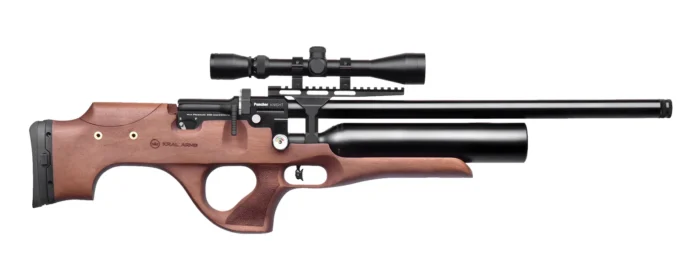
KRAL KNIGHT WALNUT
Price range: €700.00 through €730.00
Kral is ready for battle with their latest PCP offering, the Knight! Packed full of enticing features, set into a well figured Turkish Walnut or synthetic stock.
The Knight also comes with many features that Kral owners know and love! A fully shrouded barrel, smooth side lever, reliable magazine system and easy to use power adjuster are all found on the Knight. For those that like high shot counts the 500cc bottle has you covered.
- Calibre: 0.177
- Capacity: 14
- Material: Turkish Walnut
- Power: 11.5 ft-lbs
- Stock: Semi Bullpup
- Thread: 1/2″ unf
NB. Scope and Mounts not included
KRAL KNIGHT WALNUT
Kral Knight Walnut Overview, Design, and Construction
What Is the Kral Knight Walnut?
The Kral Knight Walnut is a precision-oriented pneumatic platform distinguished by its traditional walnut exterior and modern engineering approach. Designed within the broader Kral product family, the platform combines a classic appearance with the technical characteristics associated with contemporary pre-charged pneumatic systems.
The Kral name is associated with a broad range of pneumatic products, and searches may therefore include terms such as Kral, Kral Arms, Kral Puncher, Kral Air Rifle, Kral Arms Airguns, Kral Arms PCP Rifle, Kral Puncher PCP, and Kral Puncher Series. These terms should be distinguished from the exact Knight Walnut configuration when publishing technical information.
Walnut Construction and Appearance
One of the most immediately recognizable characteristics of the Kral Knight Walnut is its walnut construction. Natural walnut provides a traditional appearance that differs substantially from synthetic configurations.
The grain pattern gives each individual stock a distinctive visual character. Consequently, no two natural walnut stocks should necessarily be expected to look identical.
Walnut also requires appropriate environmental care. Prolonged exposure to moisture, excessive heat, direct sunlight, or unsuitable chemicals can affect the appearance and condition of natural wood.
For that reason, the stock should be maintained in a clean, dry, and reasonably stable environment.
PCP Architecture
The platform uses a pre-charged pneumatic operating principle in which compressed air is stored within a dedicated pressure system.
Because stored compressed air represents potential energy, the pressure-bearing system should be treated as specialized equipment. Manufacturer documentation should be followed for inspection, maintenance, storage, and servicing.
The pressure system should not be drilled, cut, heated, welded, reshaped, or modified through improvised methods.
Precision and Consistency
Precision is best considered through consistency rather than a single isolated result.
Environmental conditions, equipment condition, compatible components, sighting equipment, and operator consistency can all influence observed results. Therefore, generalized claims from unrelated Kral models should not automatically be applied to the Knight Walnut.
A technically accurate product description should distinguish confirmed manufacturer specifications from general characteristics of the product category.
Kral Product Family and Search Intent
Online searches can connect the Kral brand with numerous product terms, including Kral NP 02, Kral Puncher Mega, Puncher Auto, Empire X, KR9, KP12, KR-101, Bigmax, and other configurations.
Likewise, terms such as Kral Breaker Puncher, Kral Puncher Breaker, Kral Puncher Breaker Walnut, Kral Puncher Breaker Synthetic, and Kral Arms Puncher Breaker PCP Air Rifle may appear alongside searches for other Kral products.
These should not be treated as interchangeable specifications. Each model should be identified using its own manufacturer documentation.
Why Walnut Matters
Walnut provides more than a traditional visual appearance. Its natural grain contributes to the individuality of the product, while its established use in sporting equipment gives the platform a classic character.
However, natural wood requires more environmental awareness than many synthetic materials.
A walnut stock should be protected from unnecessary moisture and extreme temperature changes. After exposure to damp conditions, appropriate drying should be allowed before long-term storage.
How the Design Supports Ownership
The combination of traditional walnut construction and contemporary pneumatic architecture creates a product intended to bridge classic styling with modern equipment design.
The external appearance can be particularly relevant to buyers who value natural materials, while the pneumatic architecture provides a modern engineering foundation.
At the same time, responsible ownership remains important. The equipment should be securely stored, regularly inspected, and maintained according to appropriate technical documentation.
Where the Product Should Be Maintained
Storage should take place in a secure environment that limits unauthorized access and protects the walnut stock and metal components from unnecessary environmental exposure.
A stable, reasonably dry location is preferable. The equipment should not be left exposed to persistent humidity, excessive heat, or unnecessary physical impact.
Where lawful activities involving projectile equipment are permitted, appropriate controlled facilities and applicable local requirements should be followed.
Important Product Identification
Search terms such as A12 shotgun, XM shotgun, .223 rifles, .223 guns, AKR gun, 410 shotgun semi auto magazine fed, kalibre pistol, and tabancalar describe different product categories and should not be presented as characteristics of the Kral Knight Walnut.
Similarly, terms such as rifle cal 22 semiautomatico, KR9 rifle, and other model-specific phrases should only be associated with this product when manufacturer documentation confirms their relevance.
Overall Product Character
The Kral Knight Walnut combines traditional natural-material styling with a modern pneumatic platform. Its defining characteristics are therefore its walnut construction, PCP architecture, engineered mechanical assemblies, and emphasis on consistent product care.
For accurate caliber, dimensions, reservoir specifications, accessories, operating limitations, and other technical information, the exact manufacturer documentation for the Kral Knight Walnut should remain the primary reference.
This approach ensures that the product is described accurately while preserving the distinction between the Knight Walnut and other products within the wider Kral range.
Construction, Durability, and Maintenance
The Kral Knight Walnut is defined by the combination of a traditional natural-material stock and a modern pneumatic mechanical system. As a result, long-term ownership involves two different categories of care. The walnut exterior benefits from controlled environmental conditions and gentle maintenance, while the internal mechanical and pressure-related assemblies require appropriate technical attention.
The overall condition of the product is influenced by storage, transportation, humidity, temperature, cleaning practices, and inspection. Therefore, good maintenance should be approached as a continuing process rather than as an occasional task performed only when a visible problem appears.
Natural Walnut Construction
Walnut is valued for its distinctive grain, traditional appearance, and natural variation. Each stock can therefore have its own visual character, with differences in grain direction, color, and figure.
This natural variation should be regarded as part of the material rather than as a manufacturing defect.
At the same time, natural wood responds to its environment. Changes in humidity and temperature can influence the material over time. Prolonged exposure to damp conditions can affect the surface, while excessive dryness or heat may also be undesirable.
For this reason, the stock should be stored in a reasonably stable environment.
Protecting the Walnut Surface
The exterior should be kept clean and reasonably dry.
Dust can be removed using an appropriate soft material that will not unnecessarily scratch the surface. Strong chemicals should not be applied unless their compatibility with the particular finish has been established.
Aggressive polishing should also be avoided when it is unnecessary.
The objective of routine care should be preservation rather than repeated cosmetic restoration.
Humidity and Natural Wood
Humidity is one of the most important environmental considerations for natural wood.
A persistently damp environment can contribute to changes in the appearance and condition of the stock. However, sudden movement between significantly different environments can also create challenges.
The product should therefore be protected from prolonged moisture and stored where environmental conditions are reasonably stable.
After exposure to rain or condensation, the exterior should be allowed to dry appropriately before long-term storage.
Temperature Considerations
Extreme temperatures should be avoided where practical.
An enclosed vehicle can become substantially hotter than the surrounding environment. Similarly, very cold conditions can create different material and condensation concerns.
Rapid movement from a cold environment into a warm, humid environment can produce condensation on cooler surfaces.
A stable storage environment is therefore preferable.
Inspecting the Walnut
Regular visual inspection can help establish whether the stock remains in its expected condition.
Attention can be given to cracks, unusual deformation, surface separation, significant scratches, impact marks, or other changes.
Not every cosmetic mark represents a structural concern.
However, a substantial crack or unexplained change should not be dismissed without consideration.
Where the significance of a structural change is uncertain, professional inspection is appropriate.
Grain and Natural Variation
Natural walnut does not have a uniform manufactured appearance.
Grain patterns can vary from one stock to another. Color can also differ across different sections of the same stock.
This means that photographs of another example should not necessarily be used to represent the precise appearance of an individual product.
Natural variation is an inherent characteristic of genuine wood construction.
Mechanical Construction
Behind the external stock is a collection of mechanical and pneumatic assemblies.
These components operate together as a complete system.
The external structure supports the mechanical assemblies, while the pneumatic system manages stored compressed air.
Because the assemblies interact, a change observed in one area should not automatically be attributed to one particular component.
Pressure System
The pressure system deserves particular attention because compressed air represents stored energy.
Pressure-bearing components should remain in their intended configuration.
They should not be drilled, cut, welded, heated, reshaped, or otherwise modified through improvised procedures.
Pressure-related servicing should follow appropriate manufacturer documentation or be performed by qualified personnel.
Pressure Retention
A change in pressure behavior can have several possible causes.
Seals, valves, connections, or other pneumatic components may contribute to an unexpected change.
Repeatedly restoring pressure without identifying the underlying cause does not resolve the condition.
Where pressure behavior differs significantly from the established condition, appropriate technical inspection should be obtained.
Seals and Material Aging
Seals can change gradually over time.
Temperature, environmental exposure, storage conditions, and normal material aging can influence their condition.
When a seal-related problem is suspected, replacement should use an appropriate component for the exact configuration.
Improvised replacement materials should not be assumed to have equivalent properties.
Valve Components
Valve assemblies form an important part of the pneumatic system.
Their condition can influence overall system behavior.
Unusual pressure changes or other unexpected characteristics should therefore receive appropriate attention.
Internal servicing should not be treated as ordinary surface maintenance. Where specialized knowledge or equipment is required, professional servicing is preferable.
Barrel Protection
The barrel should be regarded as a precision component.
It should not be used as a handle, lever, or support point.
During transportation, unnecessary contact with hard surfaces should be avoided.
The opening should remain protected from foreign material and contamination.
Following a significant impact, appropriate inspection should be completed before normal handling resumes.
Precision Components
Precision components can be affected by impact, contamination, corrosion, and inappropriate maintenance.
For that reason, careful storage and transportation are important.
The product should not be placed where it can repeatedly strike hard surfaces.
Likewise, cleaning procedures should be selected according to the manufacturer’s recommendations.
Mechanical Interfaces
The various mechanical interfaces should remain secure.
Unexpected looseness, unusual movement, or changes in normal mechanical behavior should receive attention.
A component that does not move normally should not be forced.
Applying excessive force can potentially make an existing problem more serious.
Trigger Assembly
The trigger assembly should remain in its intended configuration.
Changes in normal movement or resistance should not automatically be treated as harmless.
Unauthorized modification can introduce uncertainty into the mechanical system.
When an abnormality develops, appropriate technical inspection should be considered.
Stock and Action Relationship
The stock and mechanical assemblies work together as an integrated structure.
The interfaces between these areas should therefore be inspected periodically.
Unusual movement, visible separation, or significant damage should receive attention.
The equipment should not be repeatedly handled in a manner that places unnecessary stress on these interfaces.
Cleaning the Product
Cleaning should be controlled and purposeful.
The goal should be to remove ordinary contamination while preserving the original materials and finishes.
A suitable soft material can be used for appropriate external surfaces.
Excessive moisture should be avoided.
Cleaning products should not be selected simply because they are strong. Compatibility with the particular surface is more important.
Cleaning the Walnut
The walnut surface requires particular care.
The finish should be preserved rather than aggressively stripped.
Harsh solvents should not be used unless specifically supported for the relevant finish.
Abrasive materials should also be avoided where they could alter the appearance of the wood.
Routine cleaning should remain gentle and controlled.
Cleaning Metal Components
Metal surfaces should be kept reasonably clean and dry.
After exposure to moisture, appropriate drying should take place.
Where corrosion is suspected, the location and severity should be considered before any treatment is attempted.
Aggressive removal methods can potentially damage a surface or alter a component.
Corrosion Prevention
Corrosion prevention begins with environmental control.
A dry storage environment can reduce prolonged exposure to moisture.
Regular inspection can identify discoloration and surface changes.
After damp exposure, appropriate drying can reduce the opportunity for moisture to remain against metal surfaces.
Existing Corrosion
Corrosion should not automatically be treated as a cosmetic issue.
Its significance depends on where it occurs.
Surface discoloration can differ substantially from corrosion affecting an important mechanical or pressure-bearing component.
When the significance is uncertain, professional inspection is appropriate.
Lubrication Considerations
Lubrication requirements depend on the specific design.
Only products supported by appropriate technical documentation should be used.
Excessive lubricant can attract dust and create additional contamination.
An unsuitable product can also affect certain materials or seals.
Consequently, lubrication should follow the manufacturer’s recommended maintenance procedure rather than assumptions based on unrelated equipment.
Dust Management
Dust can accumulate during storage.
Fine particles may settle around mechanical interfaces and exposed areas.
The storage environment should therefore be kept reasonably clean.
The protective case should also be inspected and cleaned periodically.
A dirty case can transfer contamination back onto equipment that has already been cleaned.
Protective Case
A suitable protective case can reduce unnecessary physical impact during transportation.
The case should itself be maintained.
Latches should remain functional.
Hinges should remain secure.
Padding should remain capable of providing appropriate protection.
The interior should be kept clean and dry.
Transportation
Transportation exposes the product to vibration, movement, impacts, temperature changes, and potentially moisture.
The product should be appropriately secured within suitable protective packaging.
Unnecessary movement should be minimized.
The protective case should prevent avoidable contact with hard surfaces.
Applicable transportation requirements should also be verified for the relevant jurisdiction.
Long-Term Storage
Before extended storage, the product should be inspected.
The walnut should be clean and dry.
Metal surfaces should be checked.
The storage case should be suitable.
The environment should be secure and reasonably stable.
After prolonged storage, another inspection should be performed before normal handling resumes.
Secure Storage
Secure storage is an essential part of responsible ownership.
Children and unauthorized individuals should not have access.
The storage environment should provide reasonable protection against moisture, excessive temperatures, physical impact, and environmental contamination.
Where applicable regulations establish specific storage requirements, those requirements should be followed.
Household Environment
A shared household requires careful access control.
The product should not be left openly accessible.
Visitors should not handle specialized equipment without appropriate authorization and supervision.
Security should remain effective when the owner is away.
Maintenance Records
A maintenance record can provide useful information throughout the service life.
Inspection dates can be documented.
Cleaning can be recorded.
Professional servicing can be noted.
Storage periods can be listed.
Significant environmental exposure can also be recorded.
This creates a useful history that allows the current condition to be compared with previous observations.
Why Documentation Matters
Long-term ownership can extend across many years.
As time passes, it becomes increasingly difficult to remember exactly when cleaning, inspection, or servicing occurred.
A written record provides a more reliable reference.
It can also provide useful information to a technician if professional servicing becomes necessary.
Replacement Components
Replacement components should correspond to the exact configuration.
A component that physically fits does not automatically provide appropriate technical compatibility.
This is particularly important for pressure-related, sealing, structural, and precision components.
Manufacturer documentation should therefore be consulted before replacement components are selected.
Preserving the Original Configuration
Maintaining the original configuration simplifies future inspection.
Unnecessary modifications introduce additional variables.
They can make troubleshooting more complicated and make it harder to establish whether a change resulted from normal wear, environmental exposure, maintenance, or modification.
Manufacturer-supported components and procedures should therefore be preferred.
Inspection After Impact
A substantial fall or collision should trigger additional inspection.
The external appearance may remain relatively normal even when an internal component has been affected.
For this reason, visual inspection alone cannot always establish complete mechanical condition.
Where a significant impact has occurred, professional assessment can provide greater confidence.
Inspection After Moisture Exposure
After exposure to rain or condensation, the product should be inspected.
Moisture should be removed appropriately.
The walnut should be allowed to dry naturally under suitable conditions.
The storage case should also be checked.
If important mechanical or pressure-related areas have been affected, professional assessment should be considered.
Inspection After Extended Storage
Equipment removed from extended storage should be inspected before normal handling resumes.
The walnut should be checked.
Metal surfaces should be examined.
The storage case should be inspected.
Maintenance records should be reviewed.
Any unexplained change should receive appropriate attention.
Professional Servicing
Professional servicing is appropriate when a condition extends beyond routine maintenance.
Examples include unexplained pressure changes, significant corrosion, structural damage, suspected internal component problems, or abnormal mechanical behavior.
A qualified technician can evaluate the equipment using appropriate procedures.
Professional servicing can also help preserve the intended configuration.
Manufacturer Documentation
Manufacturer documentation should remain the principal technical reference.
It may contain model-specific information concerning maintenance, storage, servicing, inspection, approved components, and operating limitations.
Information associated with another configuration should not automatically be applied.
This distinction is particularly important when several products share similar names.
Responsible Ownership
Responsible ownership combines maintenance, security, and environmental awareness.
The product should be maintained appropriately.
It should be stored securely.
Transportation should be carefully managed.
Environmental exposure should be minimized.
Unauthorized modifications should be avoided.
Significant changes should receive appropriate technical attention.
Applicable legal requirements should also be understood.
Product Longevity
Long-term condition is supported by consistent care.
A stable storage environment can help protect the walnut.
Appropriate cleaning can preserve surfaces.
Careful transportation can reduce physical damage.
Regular inspection can identify changes earlier.
Professional servicing can address conditions beyond routine maintenance.
Secure storage can reduce unauthorized access and accidental damage.
Practical Long-Term Routine
A straightforward routine can be maintained throughout the product’s service life.
The exterior should be inspected periodically.
The walnut should be kept clean and appropriately protected.
Metal surfaces should be checked for corrosion.
The storage environment should be reviewed.
The protective case should be maintained.
Maintenance records should be updated.
Moisture exposure should be addressed promptly.
Significant impacts should trigger additional inspection.
Unusual pressure behavior should receive appropriate technical attention.
Professional servicing should be obtained whenever routine care is no longer sufficient.
Overall Perspective
The Kral Knight Walnut combines natural walnut construction with a specialized pneumatic mechanical system.
Its long-term condition therefore depends on both material care and technical maintenance.
The walnut benefits from stable environmental conditions.
Metal components benefit from moisture control.
Precision components benefit from careful transportation.
Pressure-bearing components require appropriate technical handling.
Secure storage protects both the equipment and the surrounding household.
Final Perspective
The strongest foundation for long-term ownership is preventative care.
The walnut should be protected from unnecessary moisture, heat, and harsh chemicals.
Mechanical components should be inspected regularly.
Pressure-related components should remain in their intended configuration.
Transportation should be performed using suitable physical protection.
Storage should be secure, dry, and reasonably stable.
Maintenance should follow manufacturer documentation rather than improvised procedures.
Whenever significant damage, unexplained pressure behavior, abnormal mechanical movement, or other important changes are identified, normal handling should be discontinued until the condition has been appropriately assessed.
With consistent care and appropriate technical attention, the product can be preserved in its intended condition while its distinctive natural-material appearance and specialized mechanical construction are properly maintained.
Reliability, Precision, Inspection, and Long-Term Ownership
Long-term reliability is developed through consistent care, appropriate storage, regular inspection, and responsible maintenance. A specialized pneumatic product should not be judged only by its appearance immediately after purchase. Its condition can change gradually as a result of environmental exposure, transportation, storage, normal material aging, and mechanical wear.
For that reason, a systematic ownership routine is useful. The objective is not to constantly interfere with the equipment, but rather to establish a reliable baseline and recognize meaningful changes when they occur.
Establishing a Baseline
A baseline provides a reference for future inspections.
When the product is new or known to be in satisfactory condition, its external appearance can be documented. The condition of the natural-material stock, visible metal surfaces, mechanical interfaces, protective case, and storage environment can all be recorded.
Photographs can be useful for documenting the external condition.
A written maintenance record can also include inspection dates, cleaning dates, professional servicing, storage periods, and significant environmental exposure.
Over time, these records can make gradual changes easier to identify.
Why Regular Inspection Matters
Some forms of deterioration develop slowly.
A small area of corrosion can gradually expand. A structural crack can become more noticeable. A mechanical interface can develop unusual movement. Environmental exposure can also affect natural materials without producing an immediate visible problem.
Regular inspection provides an opportunity to identify these changes.
It does not eliminate every possible failure, but it provides a more disciplined method of monitoring the condition of the equipment.
Visual Inspection
A visual inspection should begin with the external condition.
The stock can be checked for cracks, unusual separation, deformation, deep scratches, impact marks, or changes in its surface.
Visible metal areas can be examined for corrosion, discoloration, or other unusual changes.
Mechanical interfaces can be checked for unexpected movement or visible damage.
The protective case can also be inspected because inadequate protection during storage or transportation can contribute to unnecessary deterioration.
Cosmetic Marks Versus Structural Damage
Not every mark represents a mechanical problem.
Natural materials can develop minor surface variations through ordinary handling. Similarly, small cosmetic marks can appear on external surfaces without affecting the underlying structure.
However, a substantial crack, deformation, separation, or significant impact mark deserves additional consideration.
When the importance of a particular defect cannot be confidently established, professional assessment is preferable to experimentation.
Natural Material Monitoring
Natural wood responds to its surrounding environment.
Humidity, temperature, and prolonged exposure to unsuitable conditions can influence its appearance and physical condition.
For this reason, the storage environment should be reasonably stable.
Sudden environmental changes should also be considered because rapid transitions can produce condensation or other undesirable effects.
Humidity Control
Humidity is particularly relevant to natural-material construction.
Persistent damp conditions can affect the surface and may also contribute to corrosion on exposed metal components.
The equipment should therefore be stored in a reasonably dry environment.
After exposure to rain or condensation, appropriate drying should take place before extended storage.
The product should not be sealed inside a case while visibly damp.
Temperature Control
Extreme temperatures should be avoided whenever practical.
An enclosed vehicle can become considerably hotter than the surrounding environment. Conversely, cold conditions can create different storage challenges.
Rapid movement between cold and warm environments can also result in condensation.
A stable indoor storage environment is generally preferable for long-term preservation.
Direct Sunlight
Prolonged direct sunlight can affect some natural finishes and materials.
Although occasional exposure does not necessarily create an immediate problem, long-term storage in direct sunlight should be avoided where practical.
A shaded, stable environment provides better conditions for preserving the appearance of the stock and other external surfaces.
Moisture After Exposure
If the equipment is exposed to rain or condensation, moisture should be addressed promptly.
The exterior should be allowed to dry appropriately.
The protective case should also be checked because moisture can remain inside the case even after the external surface appears dry.
The equipment should not be placed into long-term storage while moisture remains present.
Corrosion Monitoring
Corrosion should be evaluated according to its location and severity.
Surface discoloration is not necessarily equivalent to deterioration of an important mechanical or pressure-related component.
Consequently, corrosion should not simply be removed aggressively without first understanding what material and component are affected.
Where significant corrosion is present, qualified inspection is appropriate.
Avoiding Aggressive Treatment
Grinding, sanding, scraping, or strong chemical treatment can sometimes cause more damage than the original surface problem.
This is particularly important when a component has structural, mechanical, or pressure-related significance.
The safest maintenance philosophy is therefore controlled intervention.
If the appropriate treatment is uncertain, manufacturer documentation or professional service should be consulted.
Pressure-System Awareness
Compressed air represents stored energy.
Pressure-bearing components should therefore be treated differently from ordinary external surfaces.
They should remain in their intended configuration and should not be drilled, cut, welded, heated, reshaped, or modified through improvised procedures.
Pressure-related maintenance should follow appropriate technical documentation.
Where specialized inspection or servicing is required, qualified personnel should be used.
Changes in Pressure Behavior
A change in pressure behavior can have several possible causes.
Seals, valves, connections, or other components may contribute to an unexpected change.
The cause should not be assumed without appropriate assessment.
Repeatedly restoring pressure without identifying the reason for the change does not resolve an underlying condition.
Where the equipment behaves differently from its established condition, manufacturer-approved troubleshooting or professional servicing should be considered.
Seal Aging
Seals can change as they age.
Temperature, storage conditions, environmental exposure, and normal material aging can influence their condition.
When abnormal pressure behavior occurs, seals may require professional evaluation.
Any replacement should use components appropriate to the exact configuration.
Unverified substitute materials should not be assumed to provide equivalent characteristics.
Valve Assemblies
Valve assemblies form part of the pneumatic system and can influence its overall behavior.
Unusual pressure changes or other unexpected characteristics should therefore receive appropriate attention.
Internal servicing should not be treated as ordinary external cleaning.
Where specialist knowledge, equipment, or replacement components are required, professional service is appropriate.
Precision Components
Precision components should be protected from unnecessary impact and contamination.
During transportation, they should not repeatedly contact hard surfaces.
During storage, the product should be positioned securely.
Cleaning should be performed according to appropriate technical guidance.
Unnecessary disassembly should also be avoided because it can introduce additional variables into future inspection.
Barrel Protection
The barrel should be treated as a precision component.
It should not be used as a handle, lever, or support point.
The opening should remain protected from foreign material.
During transportation, the barrel should be appropriately protected from impacts.
After a significant impact, the relevant components should be inspected before normal handling resumes.
Mechanical Interfaces
Mechanical interfaces should remain appropriately secure.
Unexpected looseness, movement, resistance, or unusual sounds can indicate that inspection is required.
A component that does not behave normally should not simply be forced into position.
Additional force can potentially worsen an existing mechanical problem.
Trigger Condition
The trigger assembly should remain in its intended configuration.
Changes in normal movement or resistance should be treated as a reason for appropriate inspection rather than as an invitation for improvised adjustment.
Unauthorized modifications can alter mechanical relationships and introduce uncertainty into future maintenance.
When an abnormality is observed, qualified assessment is preferable.
Maintenance Products
Maintenance products should be selected according to the materials being treated.
A chemical suitable for one surface may be unsuitable for another.
Natural finishes, synthetic components, metal surfaces, coatings, and seals can have different material characteristics.
Therefore, a general-purpose product should not automatically be assumed to be suitable for every component.
Manufacturer recommendations should take priority when available.
Cleaning Philosophy
Cleaning should be purposeful rather than excessive.
The goal should be to remove contamination while preserving the original materials and finishes.
A soft, suitable cleaning material can be used for appropriate external surfaces.
Excessive moisture should be avoided.
Abrasive treatment should not be used merely to remove minor cosmetic marks.
Natural Wood Care
The stock should be treated as a natural material rather than as an ordinary synthetic surface.
Its finish should be preserved.
Harsh solvents should not be used unless their compatibility has been established.
Repeated abrasive treatment can alter the appearance of the grain and finish.
Routine care should therefore remain gentle and controlled.
Metal Surface Care
Visible metal components should be kept reasonably clean and dry.
Moisture should not remain against exposed surfaces for extended periods.
After damp exposure, appropriate drying should take place.
If corrosion is observed, its significance should be considered before treatment is attempted.
Lubrication
Lubrication requirements depend on the specific design and manufacturer’s maintenance recommendations.
Only suitable products should be used.
Excessive lubricant can attract dust and create contamination.
An unsuitable lubricant can also interact adversely with certain materials.
Therefore, lubrication should not be performed simply because additional lubricant appears beneficial.
Dust Control
Dust can accumulate during transportation and storage.
Fine particles may settle around mechanical interfaces and exposed areas.
A clean storage environment reduces this accumulation.
The protective case should also be cleaned periodically.
Otherwise, dust inside the case can transfer back onto the product.
Protective Case Maintenance
A protective case is an important part of transportation and storage.
Its latches should function correctly.
Hinges should remain secure.
Padding should remain capable of providing suitable protection.
The interior should remain clean and dry.
If the case is damaged, its protective effectiveness should not be assumed to remain unchanged.
Transportation
Transportation can expose equipment to vibration, impact, temperature changes, moisture, and unauthorized access.
A suitable protective case can reduce several of these risks.
The product should be positioned securely within the case.
Unnecessary movement should be minimized.
Applicable transportation requirements should also be verified for the relevant jurisdiction.
Vehicle Storage
Vehicle interiors can experience extreme temperatures.
During hot conditions, temperatures inside an enclosed vehicle can become substantially higher than the surrounding environment.
Cold conditions can also create challenges.
Rapid temperature changes can produce condensation.
For these reasons, prolonged storage inside a vehicle should be avoided where practical.
Long-Term Storage
Before extended storage, the equipment should be inspected.
The natural-material stock should be clean and appropriately dry.
Visible metal surfaces should be checked.
The protective case should be suitable.
The storage location should be secure and reasonably stable.
After a prolonged storage period, another inspection should be completed before normal handling resumes.
Secure Storage
Secure storage protects both the equipment and people around it.
Children and unauthorized individuals should not have access.
The storage environment should protect the product from unnecessary physical impact, moisture, excessive temperature, and environmental contamination.
Where local regulations specify particular storage arrangements, those requirements should be followed.
Household Security
Shared living environments require additional attention.
The equipment should not be left in an openly accessible location.
Visitors should not handle specialized equipment without appropriate authorization and supervision.
Security should remain effective when the owner is away.
Maintenance Records
A maintenance record provides a useful history.
Inspection dates can be documented.
Cleaning can be recorded.
Professional servicing can be noted.
Storage periods can be listed.
Significant environmental exposure can also be documented.
This history can help distinguish gradual changes from sudden events.
Service History
A service history can become particularly valuable over several years.
When professional maintenance occurs, the date and general nature of the service can be recorded.
Replacement components can also be documented where appropriate.
If another service becomes necessary later, this information can provide useful background.
Replacement Components
Replacement components should correspond to the exact configuration.
Physical fit does not automatically establish technical compatibility.
This is particularly important for pressure-related, sealing, structural, and precision components.
Manufacturer documentation should therefore be consulted before replacements are selected.
Improvised substitutions should be avoided.
Preserving the Original Configuration
Preserving the original configuration simplifies future maintenance.
Unnecessary alterations introduce additional variables.
They can make troubleshooting more complicated and make it harder to establish whether a later change resulted from normal wear, environmental exposure, servicing, or modification.
Manufacturer-supported components and procedures should therefore be preferred.
Inspection After Impact
A substantial fall or collision should trigger additional inspection.
The exterior may appear normal even when an internal component has been affected.
Visual appearance alone cannot always establish complete mechanical condition.
Where significant impact has occurred, professional assessment can provide greater confidence.
Inspection After Extended Storage
Equipment removed from long-term storage should be inspected before normal handling resumes.
The stock should be checked for changes.
Metal surfaces should be examined.
The protective case should be inspected.
Maintenance records should be reviewed.
Any unexplained change should receive appropriate attention.
Professional Servicing
Professional servicing is appropriate when a condition extends beyond routine maintenance.
Examples include unexplained pressure changes, significant corrosion, structural damage, suspected internal component problems, or abnormal mechanical behavior.
A qualified technician can assess the equipment using suitable procedures.
Professional servicing can also help preserve the intended configuration.
Manufacturer Documentation
Manufacturer documentation should remain the primary technical reference.
It can provide model-specific information concerning maintenance, storage, servicing, inspection, approved components, and limitations.
Information associated with another configuration should not automatically be applied.
This is particularly important when products share similar design characteristics or naming conventions.
Responsible Ownership
Responsible ownership combines physical care, security, environmental awareness, and appropriate technical judgment.
The product should be maintained according to reliable documentation.
It should be stored securely.
Transportation should be carefully managed.
Environmental exposure should be minimized.
Unauthorized modifications should be avoided.
Significant changes should receive appropriate technical attention.
Applicable legal requirements should also be understood.
Controlled Environments
Where lawful activities involving projectile equipment are permitted, an appropriate controlled environment should be used.
Facility requirements should be confirmed when necessary.
Established procedures should be followed.
The surrounding area should also be considered.
Environmental Awareness
Responsible ownership includes awareness of the environment surrounding the equipment.
The potential projectile path should be appropriately contained.
People, occupied buildings, roads, and uncontrolled areas should not be exposed to foreseeable hazards.
Environmental awareness should extend beyond the immediate location.
Protective Equipment
Appropriate protective equipment should be used according to facility requirements and responsible practice.
Eye protection is particularly relevant in environments involving projectile equipment.
Protective equipment should fit correctly and should not interfere with awareness of the surrounding environment.
Operator Knowledge
The owner should understand the limits of personal technical knowledge.
Specialized pneumatic equipment should not be treated as ordinary household machinery.
Anyone unfamiliar with the system should obtain appropriate instruction before handling it.
When a pressure-related, structural, or mechanical condition cannot be confidently evaluated, qualified assistance should be obtained.
Preventative Maintenance
Preventative maintenance is generally preferable to waiting for a significant failure.
Regular inspection can identify developing corrosion.
Appropriate storage can reduce environmental deterioration.
Careful transportation can reduce physical damage.
Maintenance records can reveal gradual changes.
Professional servicing can address conditions beyond routine care.
Long-Term Reliability
Long-term reliability is supported by consistency.
The product should be inspected regularly.
The natural-material stock should be protected from unsuitable environmental conditions.
Visible metal components should be kept reasonably clean and dry.
The equipment should be protected during transportation.
It should be stored securely.
Manufacturer recommendations should be followed.
Unauthorized modifications should be avoided.
Significant changes should be investigated.
Practical Long-Term Routine
A straightforward ownership routine can be maintained throughout the product’s service life.
First, inspect the exterior.
Next, compare the current condition with previous records where available.
Then, perform routine maintenance according to manufacturer guidance.
After moisture exposure, dry and inspect the equipment appropriately.
Before extended storage, ensure that the product and storage environment are clean and dry.
During transportation, provide suitable protection.
After significant impact or prolonged storage, complete another inspection.
Whenever a condition exceeds routine maintenance, seek qualified professional assistance.
Overall Assessment
The product combines natural-material construction with a specialized pneumatic mechanical system.
Its long-term condition depends on the interaction between materials, mechanical assemblies, pressure-related components, environmental exposure, storage, and transportation.
Consistent care provides a stronger foundation for preservation than occasional maintenance.
Final Perspective
Reliable long-term ownership is based on prevention.
Regular inspection establishes a useful baseline.
Appropriate cleaning preserves surfaces.
Stable environmental conditions protect natural materials.
Secure storage reduces unauthorized access.
Careful transportation reduces unnecessary physical damage.
Professional servicing provides an appropriate solution when a condition exceeds routine care KRAL KNIGHT WALNUTKRAL KNIGHT WALNUTKRAL KNIGHT WALNUTKRAL KNIGHT WALNUTKRAL KNIGHT WALNUT. KRAL KNIGHT WALNUTKRAL KNIGHT WALNUTKRAL KNIGHT WALNUTKRAL KNIGHT WALNUT.
Most importantly, unexplained pressure behavior, significant corrosion, structural damage, abnormal mechanical movement, or other important changes should not be ignored. When a condition cannot be confidently assessed, normal handling should be discontinued and qualified professional assistance should be obtained KRAL KNIGHT WALNUTKRAL KNIGHT WALNUTKRAL KNIGHT WALNUTKRAL KNIGHT WALNUTKRAL KNIGHT WALNUTKRAL KNIGHT WALNUTKRAL KNIGHT WALNUTvKRAL KNIGHT WALNUTKRAL KNIGHT WALNUT KRAL KNIGHT WALNUTKRAL KNIGHT WALNUTKRAL KNIGHT WALNUTKRAL KNIGHT WALNUT.
Be the first to review “KRAL KNIGHT WALNUT”
Related products

Kral Arms

Kral Arms

Kral Arms


Kral Arms


Kral Arms

Kral Arms
Reviews
There are no reviews yet.