


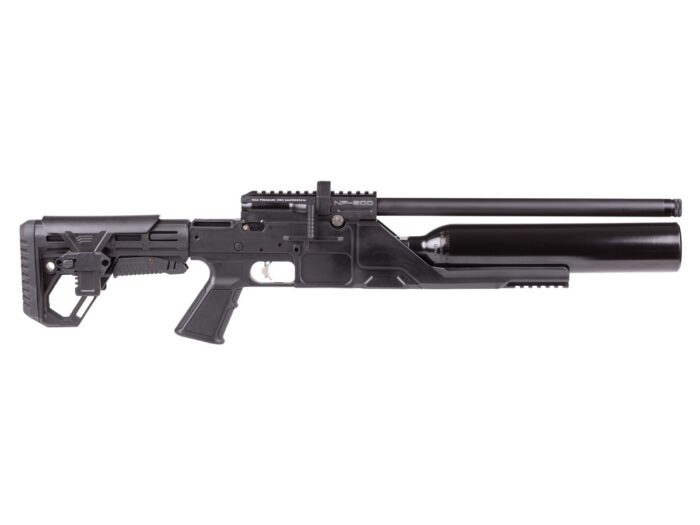
KRAL ARMS PUNCHER EMPIRE XS WALNUT
€499.00
-
The Kral Arms Empire XS is a powerful PCP air rifle in bullpup configuration (and bullpup cocking). Features height adjustable buttpad this is an ultra compact air rifle that packs a punch well above its size. The ergonomically shaped Turkish walnut stock provides a stable and comfortable grip. Both first and second stage of the trigger can be adjusted and there’s even an adjustable trigger blade.
To facilitate mounting a rifle scope or red dot, the Kral Arms Empire XS features a Weaver/Picatinny rail, that double as a carrying rail.
If you are looking for a compact, easy to handle and maneuver full power airgun without breaking the bank then look no further!
Specification:
- Calibre: .177/.22
- Capacity: 14
- Length: 61cm
- Power: 11.5
- Stock: Turkish Walnut
- Tube Size: 200cc
11.5 ft-lbs
- Stock: Bullpup
- Thread: 1/2″ unf
NB. Scope and Mounts not included
KRAL ARMS PUNCHER EMPIRE XS WALNUT
Kral Arms Puncher Empire XS Walnut Overview
What Is the Kral Arms Puncher Empire XS Walnut?
The Kral Arms Puncher Empire XS Walnut combines traditional walnut styling with contemporary pneumatic engineering. Designed for enthusiasts who appreciate natural materials alongside modern equipment design, the platform presents a distinctive balance between classic appearance, practical handling, and technical construction.
The product belongs to the wider Kral ecosystem, where searches may include Kral, Kral Arms, Kral Puncher, Kral Air Rifle, Kral Arms Airguns, Kral Arms PCP Rifle, Kral Puncher PCP, and Kral Puncher Series. However, those terms cover multiple configurations, so specifications should always be confirmed against the exact Empire XS Walnut model.
Walnut Construction and Classic Styling
The walnut stock is one of the defining visual characteristics of this configuration. Natural walnut provides individual grain patterns, variations in color, and a traditional appearance that differs from synthetic alternatives.
Consequently, every genuine walnut stock can have its own visual character. Small differences in grain and figure should therefore be regarded as natural material variation rather than inconsistency.
The walnut should be protected from prolonged moisture, excessive heat, direct sunlight, and unsuitable cleaning chemicals. With appropriate care, the natural appearance can be preserved throughout long-term ownership.
Modern Pneumatic Architecture
The platform uses pneumatic engineering rather than relying on conventional firearm operating principles. Compressed air provides the energy source, while the mechanical assemblies are designed to work together as an integrated system.
Because compressed air stores energy, pressure-related components should be treated as specialized equipment. They should remain in their intended configuration and should not be drilled, cut, heated, welded, or modified through improvised procedures.
Why Consider This Configuration?
The Empire XS Walnut can appeal to users who want contemporary pneumatic equipment without sacrificing the visual character associated with traditional sporting stocks.
Furthermore, the combination of natural walnut and modern mechanical architecture gives the product a distinctive identity within the broader Kral range.
Ergonomics, balance, external controls, sighting compatibility, and overall dimensions should nevertheless be evaluated according to the exact configuration and manufacturer’s documentation.
Precision and Consistency
Precision should be understood through repeatability under consistent conditions rather than through a single isolated result.
Environmental conditions, equipment condition, compatible accessories, ammunition or projectile selection, and user consistency can all influence observed results.
Therefore, generalized claims associated with other products should not automatically be applied to the Empire XS Walnut.
This distinction is particularly important because online searches frequently combine terms such as Kral NP 02, Puncher Mega, Puncher Auto, Empire X, NP500, KR9, and other configurations.
Understanding Related Search Terms
The Kral product family is broad, and search results can include terms such as Kral Breaker Puncher, Kral Puncher Breaker Air Rifle, Kral Puncher Breaker Synthetic, Kral Puncher Breaker Walnut, and Kral Arms Puncher Breaker PCP Air Rifle.
These phrases may describe related products, but they should not be presented as interchangeable specifications of the Empire XS Walnut.
Likewise, searches containing A12 shotgun, XM shotgun, 223 rifles, .223 guns, AKR gun, KP12, K12 shotgun, 410 shotgun semi auto magazine fed, kalibre pistol, or tabancalar refer to different categories and should not be treated as features of this product.
Where and When Is It Appropriate?
The product should only be used in lawful, controlled environments appropriate for the exact equipment and local regulations.
A suitable environment should provide appropriate containment and separation from people, occupied buildings, roads, and uncontrolled areas.
Before ownership, transportation, storage, or use, applicable requirements should be checked for the relevant jurisdiction.
How Should It Be Maintained?
Routine care should focus on keeping the exterior clean and dry while following the manufacturer’s maintenance documentation.
The walnut stock should be protected from excessive moisture and unsuitable chemicals. Visible mechanical components should be inspected periodically, while pressure-related servicing should be handled according to appropriate technical procedures.
After significant impact, unusual mechanical behavior, or substantial environmental exposure, additional inspection may be appropriate.
Overall Product Character
The Kral Arms Puncher Empire XS Walnut brings together traditional walnut styling and contemporary pneumatic engineering. Its natural-material construction provides an individual appearance, while its modern platform reflects the development of contemporary sporting airgun design.
For accurate information concerning caliber, dimensions, pressure specifications, accessories, and other technical characteristics, the exact manufacturer’s documentation for the Empire XS Walnut should remain the authoritative reference.
Construction, Maintenance, Durability, and Responsible Ownership
Long-term ownership of specialized pneumatic equipment depends on more than the condition of its exterior. Materials, environmental conditions, storage, transportation, inspection, and appropriate servicing all influence how well a product is preserved over time.
The combination of a natural-material exterior and a mechanical pneumatic system requires a balanced maintenance approach. The external surfaces benefit from careful handling and environmental protection, while internal and pressure-related components require attention to manufacturer instructions and appropriate technical service.
Natural Material and Surface Preservation
Natural wood has characteristics that distinguish it from synthetic materials. Grain, color, figure, texture, and surface appearance can vary naturally between individual examples. These differences should be regarded as characteristics of the material rather than automatically interpreted as imperfections.
At the same time, natural material responds to its surroundings. Prolonged exposure to moisture, excessive heat, very dry conditions, or rapid environmental changes can influence its appearance and condition.
For long-term preservation, the exterior should be kept reasonably clean and dry. Unnecessary exposure to rain, condensation, direct sunlight, and extreme temperatures should be avoided whenever practical.
Protecting the Finish
The finish should be maintained rather than aggressively restored.
Dust and ordinary surface contamination can normally be removed using an appropriate soft material. Cleaning should remain gentle, particularly when the type of finish has not been established.
Strong solvents, abrasive compounds, aggressive polishing materials, and unsuitable household chemicals should not be applied simply because they appear effective at removing dirt.
Different finishes react differently to chemicals. Consequently, compatibility should be established before any specialized cleaning product is used.
Environmental Conditions
The storage environment has an important influence on long-term condition.
A secure, reasonably dry, and stable location is preferable. Excessive humidity should be avoided because persistent moisture can contribute to corrosion and can affect natural materials.
Extreme heat should also be avoided. Enclosed vehicles can reach temperatures considerably higher than the surrounding environment, making them unsuitable for prolonged storage.
Cold environments can present different concerns, particularly when equipment is moved rapidly into a warm and humid environment.
Condensation
Condensation deserves particular attention because it can appear even when the equipment has not been directly exposed to rain.
When a cold object is brought into a warm environment, moisture can form on cooler surfaces. If the equipment is immediately placed into closed storage, that moisture may remain trapped.
Allowing the equipment to stabilize under appropriate conditions can reduce this concern.
The same principle applies to protective cases. A case should not be closed for extended storage while moisture remains inside.
Moisture Exposure
After exposure to rain or substantial condensation, the equipment should be inspected.
Visible moisture should be removed appropriately, and the exterior should be allowed to dry under suitable conditions.
The storage case should also be examined.
If moisture has reached important mechanical or pressure-related areas, routine external cleaning may not be sufficient. In such circumstances, qualified technical inspection should be considered.
Inspection Routine
A periodic inspection provides an opportunity to establish whether the current condition remains consistent with previous observations.
The exterior can be examined for cracks, deformation, corrosion, unusual movement, impact marks, or other changes.
A simple record can be maintained to document inspection dates and significant observations.
This becomes particularly useful when ownership continues over several years.
Cosmetic Damage and Structural Damage
Not every visible mark represents a structural problem.
A superficial scratch, minor finish variation, or small cosmetic mark may have limited significance. In contrast, a substantial crack, deformation, separation, or impact-related change can require professional evaluation.
The location and severity of a defect should therefore be considered rather than relying solely on its appearance.
When there is uncertainty, qualified inspection is preferable to experimentation.
Mechanical Components
The mechanical assemblies should remain in their intended configuration.
Unexpected looseness, stiffness, resistance, movement, or unfamiliar mechanical behavior should receive attention.
A component that behaves differently from its established condition should not simply be forced into position.
Applying additional force can potentially make an existing mechanical problem more serious.
Routine ownership should therefore emphasize observation and appropriate servicing rather than improvised mechanical intervention.
Pressure-Related Components
The pneumatic system requires particular caution because compressed air contains stored energy.
Pressure-bearing components should not be drilled, cut, welded, heated, reshaped, or otherwise modified through improvised methods.
Pressure-system maintenance should follow the applicable manufacturer documentation.
When specialized tools, knowledge, or inspection procedures are required, qualified technical service should be used.
Changes in Pressure Behavior
A noticeable change in pressure behavior should not simply be ignored.
Several components can contribute to a change, including seals, valves, connections, or other elements within the pneumatic system.
The underlying cause should be established through appropriate procedures.
Repeatedly restoring pressure without determining why the condition changed does not resolve the underlying issue.
Where the manufacturer does not provide a suitable troubleshooting procedure, professional inspection should be considered.
Seals and Aging
Seals can change gradually over time.
Material aging, temperature, environmental exposure, storage conditions, and normal service life can influence their condition.
A suspected sealing problem should therefore be treated as a technical maintenance issue.
Replacement components should correspond to the exact configuration.
A component that appears physically similar should not automatically be assumed to provide equivalent performance or compatibility.
Valve Assemblies
Valve assemblies are important components of a pneumatic system.
Their condition can influence pressure behavior and overall mechanical operation.
Internal valve servicing should not be approached as ordinary external cleaning.
Where specialist knowledge or equipment is required, professional servicing is preferable.
Precision Components
Precision components should be protected from unnecessary impact and contamination.
During transportation, contact with hard surfaces should be minimized.
During storage, the equipment should be positioned securely so that it cannot fall or shift unnecessarily.
Unnecessary disassembly should also be avoided.
Every additional intervention introduces another opportunity for incorrect assembly, contamination, or damage.
Barrel and Alignment Protection
The barrel should be treated as a precision component.
It should not be used as a carrying handle, lever, support point, or tool.
During transportation, appropriate physical protection should be provided.
The opening should remain protected from foreign material.
If the product experiences a substantial impact, appropriate inspection should be considered before normal handling resumes.
Trigger and Control Assemblies
Control assemblies should remain in their intended configuration.
A change in normal movement, resistance, or behavior should receive appropriate attention.
Improvised adjustment should be avoided because it can alter the mechanical relationships established by the manufacturer.
Where adjustment or servicing is required, the applicable technical documentation should be followed.
Cleaning Procedures
Cleaning should have a clear purpose.
The objective should be to remove contamination while preserving the original materials and finishes.
Different surfaces may require different cleaning methods.
Natural material, coated metal, uncoated metal, synthetic components, and sealing materials should not automatically be treated with the same products.
The safest general approach is to follow the manufacturer’s maintenance recommendations.
Avoiding Abrasive Materials
Abrasive materials can alter surfaces.
Repeated polishing or aggressive rubbing can change the appearance of finishes.
Abrasive treatment can also remove material unnecessarily.
For that reason, ordinary contamination should be addressed using the least aggressive appropriate method.
Lubrication Considerations
Lubrication requirements depend on the specific design.
Only appropriate products should be used where lubrication is required.
More lubricant does not necessarily mean better maintenance.
Excess lubricant can attract dust and create contamination around mechanical interfaces.
An unsuitable lubricant may also affect certain materials or seals.
Consequently, lubrication should be based on documented maintenance requirements rather than assumptions.
Dust and Contamination
Dust can accumulate during storage.
Fine particles may settle around exposed interfaces and external surfaces.
A clean storage environment can reduce this accumulation.
The protective case should also be kept clean.
Otherwise, contamination inside the case can transfer back onto equipment that has already been cleaned.
Protective Storage
A suitable protective case can reduce unnecessary physical impact during transportation and storage.
The case should be inspected periodically.
Latches should remain functional.
Hinges should remain secure.
Internal padding should remain capable of providing appropriate protection.
The interior should remain clean and dry.
A damaged case should not be assumed to provide the same level of protection as when it was new.
Transportation
Transportation introduces additional environmental and physical risks.
Vibration can cause movement.
Impacts can affect precision components.
Moisture can contribute to corrosion.
Temperature changes can produce condensation.
The equipment should therefore be secured appropriately during transportation.
Unnecessary movement should be minimized.
Vehicle Storage
Prolonged storage inside a vehicle should generally be avoided where practical.
Vehicle interiors can become extremely hot in direct sunlight.
They can also become very cold in certain conditions.
Rapid temperature changes can contribute to condensation.
A stable storage location is generally preferable for long-term preservation.
Long-Term Storage
Before extended storage, a basic condition check should be completed.
The exterior should be clean and dry.
Visible components should be examined.
The protective case should be clean and suitable.
The storage location should be secure.
After extended storage, another inspection should be performed before normal handling resumes.
Secure Storage
Secure storage is an essential part of responsible ownership.
Unauthorized individuals should not have access.
Children should be prevented from accessing specialized equipment.
The storage location should provide protection against unnecessary physical impact, moisture, excessive heat, and environmental contamination.
Applicable local storage requirements should also be followed.
Household Considerations
Shared households require particular attention to access control.
The equipment should not be left in an openly accessible location.
Visitors should not handle specialized equipment without appropriate authorization and supervision.
Security arrangements should remain effective when the owner is away.
Maintenance Records
A maintenance record provides useful information over time.
Inspection dates can be documented.
Cleaning can be recorded.
Professional servicing can be noted.
Storage periods can be listed.
Significant environmental exposure can also be recorded.
The purpose is not unnecessary administration. Instead, the record provides a reference that can help identify changes over time.
Service History
A service history can become increasingly useful as the equipment ages.
Dates of professional inspection can be documented.
The general nature of servicing can be recorded.
Relevant replacement components can be listed where appropriate.
If future servicing becomes necessary, this information can provide valuable background to a qualified technician.
Replacement Components
Replacement components should correspond to the exact configuration.
Physical similarity does not guarantee compatibility.
This is particularly important for pressure-related, sealing, structural, and precision components.
Manufacturer documentation should therefore be consulted before replacement components are selected.
Improvised substitutions should be avoided.
Preserving the Original Configuration
Keeping the product in its intended configuration simplifies future inspection.
Unnecessary modifications introduce additional variables.
They can complicate troubleshooting and make it more difficult to determine whether a later change resulted from ordinary wear, environmental exposure, maintenance, or modification.
Manufacturer-supported components and procedures should therefore be preferred.
Inspection After Impact
A substantial fall or collision should trigger additional inspection.
The exterior may appear normal even when an internal component has been affected.
Visual inspection alone cannot always establish complete mechanical condition.
Where significant impact has occurred, professional assessment can provide greater confidence.
Inspection After Extended Storage
Equipment removed from long-term storage should be checked before normal handling resumes.
The exterior should be examined.
Visible components should be inspected.
The protective case should be checked.
Maintenance records should be reviewed.
Any unexplained change should receive appropriate attention.
Professional Servicing
Professional servicing is appropriate when an issue extends beyond routine maintenance.
Examples include unexplained pressure changes, significant corrosion, structural damage, suspected internal component problems, or abnormal mechanical behavior.
A qualified technician can assess the equipment using appropriate procedures and model-specific information.
Manufacturer Documentation
Manufacturer documentation should remain the primary technical reference.
It may contain model-specific information regarding maintenance, storage, servicing, inspection, approved components, and operating limitations.
Information from another configuration should not automatically be transferred.
This distinction is particularly important when several products share related names or design characteristics.
Responsible Ownership
Responsible ownership combines maintenance, security, environmental awareness, and technical judgment.
The product should be stored securely.
Routine maintenance should follow appropriate documentation.
Transportation should be carefully managed.
Environmental exposure should be minimized.
Unauthorized modifications should be avoided.
Significant changes should receive appropriate technical attention.
Applicable legal requirements should also be understood.
Long-Term Durability
Durability is supported by preventative care.
Appropriate storage reduces unnecessary environmental exposure.
Careful transportation reduces physical impact.
Routine inspection helps identify changes.
Suitable cleaning preserves external materials.
Professional servicing addresses conditions that exceed ordinary maintenance.
Together, these practices provide a stronger foundation for long-term preservation.
Practical Ownership Routine
A straightforward routine can be followed throughout the service life.
The exterior can be inspected periodically.
The product can be kept clean and dry.
Visible components can be checked for corrosion or damage.
The storage environment can be reviewed.
The protective case can be maintained.
Maintenance records can be updated.
Moisture exposure can be addressed promptly.
Significant impacts can trigger additional inspection.
Unusual mechanical or pressure-related behavior can receive appropriate technical attention.
Whenever routine care is insufficient, qualified professional assistance should be obtained.
Final Perspective
The product should be regarded as a complete pneumatic system rather than simply as an external sporting object.
Its long-term condition depends on the interaction between materials, mechanical components, pressure-related assemblies, environmental conditions, transportation, and storage.
Consistent preventative care is therefore more valuable than occasional intensive maintenance.
A clean and stable storage environment protects the external materials. Careful transportation reduces unnecessary physical damage. Regular inspection establishes a useful baseline. Appropriate technical servicing addresses conditions that cannot safely be resolved through routine maintenance.
Ultimately, responsible ownership is built around prevention, documentation, secure storage, careful handling, and respect for manufacturer guidance. When significant damage, unexplained pressure behavior, structural changes, or abnormal mechanical movement is identified, normal handling should be discontinued until the condition has been appropriately assessed by qualified personnel.
Handling, Inspection, Reliability, and Long-Term Care
Long-term reliability depends on consistent care rather than occasional intervention. A specialized pneumatic product is made up of multiple materials and mechanical assemblies, and each part can respond differently to environmental conditions, transportation, storage, and normal aging.
For that reason, responsible ownership should begin with establishing a clear baseline condition. Once that baseline is understood, subsequent inspections can be compared against it. This makes it easier to distinguish ordinary cosmetic variation from a meaningful change that deserves attention.
Establishing a Baseline
A baseline can be created when the product is new or when its condition is known to be satisfactory.
The external surfaces can be examined and photographed. Visible mechanical interfaces can also be documented. The condition of the storage case and storage environment can be recorded.
A simple written record can include the inspection date and any significant observations.
This information becomes increasingly useful as ownership continues because gradual changes are easier to recognize when previous observations are available.
Why Inspection Matters
Some forms of deterioration develop slowly.
Surface corrosion may begin as a small area of discoloration. A structural change may initially be difficult to notice. A mechanical interface may gradually become loose. Environmental exposure can also influence materials without creating an immediate visible problem.
Regular inspection provides an opportunity to identify these changes before they become more complicated.
Inspection should not be confused with unnecessary disassembly. In many circumstances, external observation and comparison with established condition are sufficient to identify whether professional attention may be appropriate.
Visual Examination
A visual examination should begin with the external condition.
The finish can be checked for unusual scratches, cracks, deformation, corrosion, impact marks, or separation.
The surrounding mechanical interfaces can be observed for unexpected movement.
The storage case can also be inspected because inadequate protection during transportation can contribute to physical damage.
Minor cosmetic marks should not automatically be interpreted as structural defects. However, substantial cracks, deformation, separation, or evidence of a serious impact should receive appropriate attention.
Distinguishing Cosmetic and Structural Changes
Appearance alone does not always establish the significance of a defect.
A superficial mark may have little mechanical relevance, while a crack in an important structural area may require immediate professional assessment.
The location, size, progression, and circumstances surrounding the change should therefore be considered.
When the significance cannot be confidently established, professional inspection is preferable to attempting to determine the answer through repeated handling.
Natural Material Changes
Natural materials can change gradually over time.
Variations in grain, tone, texture, and surface appearance are normal characteristics.
However, environmental exposure can also influence natural material.
Excessive moisture, extreme dryness, heat, and rapid environmental changes should therefore be avoided where practical.
A stable storage environment provides better conditions for preserving the original appearance.
Environmental Monitoring
The storage environment should be considered part of the maintenance routine.
Humidity can contribute to corrosion.
Temperature changes can produce condensation.
Dust can accumulate.
Direct sunlight can influence some finishes.
Moisture can become trapped within a protective case.
By monitoring these conditions, unnecessary deterioration can be reduced.
Humidity
Persistent humidity can affect both natural material and exposed metal surfaces.
Moisture that remains against a surface for extended periods can create conditions that encourage corrosion.
Natural materials can also respond to prolonged environmental exposure.
A reasonably dry storage location is therefore preferable.
After significant exposure to damp conditions, appropriate drying should take place before long-term storage.
Condensation
Condensation can occur without direct exposure to rain.
When equipment moves rapidly from a cold environment into a warm and humid one, moisture can form on cooler surfaces.
This moisture can remain unnoticed, particularly around enclosed areas.
Allowing the equipment to stabilize appropriately can reduce the likelihood of trapped condensation.
The same consideration applies to the protective case.
Temperature
Extreme temperatures should be avoided where practical.
A vehicle exposed to direct sunlight can become significantly hotter than the surrounding environment.
Very cold conditions can also produce different storage concerns.
Rapid transitions between cold and warm environments can result in condensation.
A stable indoor environment is therefore preferable for long-term preservation.
Direct Sunlight
Long-term exposure to direct sunlight should be minimized.
Some finishes and external materials can be affected by prolonged ultraviolet exposure.
A shaded storage environment provides better conditions for preserving the appearance of the product.
Moisture Exposure
After exposure to rain, condensation, or unusually damp conditions, the product should be inspected.
Visible moisture should be removed appropriately.
The equipment should be allowed to dry under suitable conditions.
The protective case should also be inspected because moisture can remain inside even after the external surface appears dry.
If important internal or pressure-related components may have been affected, professional inspection should be considered.
Corrosion
Corrosion should be evaluated according to its location and severity.
Surface discoloration is not necessarily equivalent to deterioration of an important mechanical component.
For that reason, aggressive treatment should not automatically be applied.
Grinding, scraping, sanding, or strong chemical treatment can potentially create additional damage.
When corrosion affects an important area or its significance is uncertain, qualified assessment is appropriate.
Pressure-System Awareness
Compressed air contains stored energy.
Pressure-bearing components should therefore be treated as specialized assemblies.
They should remain in their intended configuration.
Drilling, cutting, welding, heating, reshaping, or other improvised modification should not be performed.
Pressure-related servicing should follow appropriate manufacturer documentation.
Where specialist equipment or knowledge is required, qualified technical service should be used.
Changes in Pressure Behavior
A change in pressure behavior should be treated as a condition requiring appropriate attention.
Possible causes can include seals, valves, connections, or other components.
The underlying cause should be established through suitable technical procedures.
Repeatedly restoring pressure without determining why a change occurred does not resolve an underlying issue.
When manufacturer guidance does not provide an appropriate solution, professional service should be considered.
Seal Condition
Seals can change with age and environmental exposure.
Temperature, storage conditions, material aging, and normal service life can all influence their condition.
If pressure behavior changes unexpectedly, the sealing system may require professional evaluation.
Replacement components should correspond to the exact configuration.
A component that appears visually similar should not automatically be considered technically interchangeable.
Valve Condition
Valve assemblies form an important part of the pneumatic system.
Unexpected pressure changes or other unusual characteristics can justify inspection.
Internal servicing should not be treated as ordinary cleaning.
Where specialist knowledge or equipment is required, qualified service is appropriate.
Precision Components
Precision components benefit from careful handling.
During transportation, unnecessary contact with hard surfaces should be avoided.
During storage, the product should be positioned securely.
The equipment should not be repeatedly moved or handled without a clear purpose.
Unnecessary disassembly should also be avoided because it can introduce contamination, incorrect assembly, or additional wear.
Barrel Protection
The barrel should be regarded as a precision component.
It should not be used as a handle, lever, support point, or tool.
The opening should remain protected from foreign material.
Suitable protection should be provided during transportation.
After a substantial impact, appropriate inspection should be completed before normal handling resumes.
Mechanical Interfaces
Mechanical interfaces should remain in their intended configuration.
Unexpected looseness, stiffness, movement, resistance, or unfamiliar mechanical behavior should receive attention.
A component that does not behave normally should not be forced.
Additional force can worsen an existing problem or create a new one.
Control Assemblies
Control assemblies should remain in their intended configuration.
A noticeable change in normal movement or resistance should be treated as an observation requiring attention.
Improvised adjustment should be avoided because it can introduce uncertainty into the mechanical system.
Where servicing or adjustment is required, the appropriate technical documentation should be followed.
Cleaning
Cleaning should be controlled and purposeful.
The objective should be to remove ordinary contamination while preserving the original surfaces.
Different materials can require different cleaning approaches.
A product suitable for one surface may not be suitable for another.
Consequently, cleaning products should be selected according to appropriate technical guidance.
Abrasive Materials
Abrasive materials should not be used simply to remove minor cosmetic marks.
Repeated aggressive polishing can change a finish.
Excessive rubbing can remove surface material.
The least aggressive suitable method should therefore be preferred for routine cleaning.
Chemicals
Strong solvents and household chemicals should not be used unless compatibility has been established.
Different materials react differently to chemical exposure.
Finishes, coatings, synthetic components, seals, and natural materials can all have different requirements.
Manufacturer recommendations should therefore take priority.
Lubrication
Lubrication requirements depend on the particular design.
Only appropriate products should be used where lubrication is specified.
Excessive lubricant can attract dust.
An unsuitable lubricant can interact with certain materials.
Lubrication should therefore follow documented maintenance requirements rather than general assumptions.
Dust Management
Dust can accumulate during storage and transportation.
Fine particles can settle around external interfaces and exposed areas.
A clean storage environment reduces accumulation.
The protective case should also be cleaned periodically.
Otherwise, contamination inside the case can be transferred back onto equipment that has already been cleaned.
Protective Case
A suitable protective case can reduce unnecessary physical impact.
However, the case itself requires periodic inspection.
Latches should remain functional.
Hinges should remain secure.
Padding should remain capable of providing suitable protection.
The interior should remain clean and dry.
A damaged case should not be assumed to provide its original level of protection.
Transportation
Transportation exposes the product to vibration, movement, impact, temperature changes, and potentially moisture.
The equipment should be secured appropriately.
Unnecessary movement should be minimized.
Suitable protective packaging should be used.
The exterior should be checked after significant transportation events.
Vehicle Environment
A vehicle should not normally be considered a long-term storage environment.
Temperatures inside an enclosed vehicle can become substantially higher or lower than outdoor conditions.
Rapid temperature changes can also produce condensation.
When transportation is necessary, the equipment should be protected and should not be left unnecessarily exposed to extreme conditions.
Long-Term Storage
Before extended storage, the product should be inspected.
The external surfaces should be clean and dry.
Visible components should be examined.
The protective case should be clean and suitable.
The storage environment should be secure and reasonably stable.
After an extended storage period, another inspection should be completed before normal handling resumes.
Secure Storage
Secure storage is essential for responsible ownership.
Unauthorized individuals should not have access.
Children should be prevented from accessing specialized equipment.
The storage environment should also protect the product from moisture, excessive temperatures, physical impact, and contamination.
Applicable local requirements should be followed.
Household Security
Shared households require careful access control.
The equipment should not be left openly accessible.
Visitors should not handle specialized equipment without appropriate authorization and supervision.
Security arrangements should remain effective when the owner is away.
Maintenance Records
A maintenance record creates a useful history.
Inspection dates can be recorded.
Cleaning can be documented.
Professional servicing can be listed.
Storage periods can be noted.
Significant environmental exposure can also be documented.
Over time, this record can help establish whether a change is gradual or recent.
Service History
A service history becomes more useful as the product ages.
Professional inspections can be dated.
The general nature of servicing can be recorded.
Relevant replacement components can be documented where appropriate.
If future servicing becomes necessary, this information can provide valuable background.
Replacement Components
Replacement components should correspond to the exact configuration.
Physical fit does not establish technical compatibility.
This is especially important for pressure-related, sealing, structural, and precision components.
Manufacturer documentation should be consulted before replacements are selected.
Improvised substitutions should be avoided.
Original Configuration
Preserving the original configuration simplifies future inspection.
Unnecessary modifications introduce additional variables.
They can complicate troubleshooting and make it more difficult to establish whether a later change resulted from normal wear, environmental exposure, maintenance, or modification.
Manufacturer-supported components and procedures should therefore be preferred.
Impact Inspection
A substantial fall or collision should trigger additional inspection.
The exterior may appear normal even if an internal component has been affected.
Visual inspection alone cannot always establish complete mechanical condition.
Where significant impact has occurred, professional assessment provides a more reliable basis for determining condition.
Extended-Storage Inspection
Equipment removed from extended storage should be inspected before normal handling resumes.
The external condition should be reviewed.
Visible components should be checked.
The storage case should be examined.
Maintenance records should be reviewed.
Any unexplained change should receive appropriate attention.
Professional Service
Professional servicing becomes appropriate when a condition extends beyond ordinary maintenance.
Examples include unexplained pressure changes, significant corrosion, structural damage, suspected internal component problems, or abnormal mechanical behavior.
Qualified technicians can evaluate the product using appropriate procedures and model-specific information.
Manufacturer Documentation
Manufacturer documentation should remain the primary technical reference.
It can provide model-specific information concerning maintenance, servicing, inspection, approved components, storage, and operating limitations.
Information from another configuration should not automatically be transferred.
This is especially important when related products have similar names or appearances.
Responsible Ownership
Responsible ownership combines maintenance, security, environmental awareness, and technical judgment.
The product should be maintained according to appropriate documentation.
It should be stored securely.
Transportation should be carefully managed.
Environmental exposure should be minimized.
Unauthorized modifications should be avoided.
Significant changes should receive appropriate attention.
Applicable legal requirements should also be understood.
Preventative Maintenance
Preventative maintenance is generally preferable to waiting for a major problem.
Regular inspection can identify developing corrosion.
Appropriate storage can reduce environmental deterioration.
Careful transportation can reduce physical damage.
Maintenance records can reveal gradual changes.
Professional servicing can address conditions beyond routine care.
Long-Term Reliability
Reliability is supported by consistency.
The product should be inspected periodically.
External surfaces should be protected from unsuitable environmental conditions.
Visible components should remain clean and dry.
Transportation should be performed with suitable protection.
Storage should remain secure.
Manufacturer recommendations should be followed.
Unauthorized modifications should be avoided.
Important changes should be investigated.
Practical Ownership Routine
A straightforward routine can be maintained throughout the service life.
The exterior can be inspected periodically.
Its condition can be compared with previous records.
Routine maintenance can be performed according to manufacturer guidance.
After moisture exposure, the equipment can be dried and inspected appropriately.
Before extended storage, the equipment and storage environment can be checked.
During transportation, suitable protection can be provided.
After significant impact or prolonged storage, an additional inspection can be completed.
Whenever an issue exceeds routine maintenance, qualified professional assistance should be obtained.
Overall Perspective
The product should be viewed as an integrated pneumatic system whose condition depends on materials, mechanical assemblies, environmental conditions, storage, transportation, and maintenance.
No single maintenance action guarantees long-term reliability.
Instead, consistent preventative care provides the strongest foundation for preserving the product.
Final Perspective
Reliable ownership begins with prevention.
Regular inspection establishes a useful baseline.
Appropriate cleaning preserves external surfaces.
Stable environmental conditions reduce unnecessary deterioration.
Secure storage protects both the equipment and the surrounding household.
Careful transportation reduces avoidable physical damage KRAL ARMS PUNCHER EMPIRE XS WALNUTKRAL ARMS PUNCHER EMPIRE XS WALNUTKRAL ARMS PUNCHER EMPIRE XS WALNUTKRAL ARMS PUNCHER EMPIRE XS WALNUT KRAL ARMS PUNCHER EMPIRE XS WALNUTKRAL ARMS PUNCHER EMPIRE XS WALNUT.
Professional servicing provides an appropriate solution when a condition exceeds routine maintenance.
Most importantly, unexplained pressure behavior, significant corrosion, structural damage, abnormal mechanical movement, or other important changes should not be ignored. When a condition cannot be confidently assessed, normal handling should be discontinued until qualified personnel have appropriately evaluated it KRAL ARMS PUNCHER EMPIRE XS WALNUTKRAL ARMS PUNCHER EMPIRE XS WALNUTKRAL ARMS PUNCHER EMPIRE XS WALNUTKRAL ARMS PUNCHER EMPIRE XS WALNUT KRAL ARMS PUNCHER EMPIRE XS WALNUTKRAL ARMS PUNCHER EMPIRE XS WALNUTKRAL ARMS PUNCHER EMPIRE XS WALNUTKRAL ARMS PUNCHER EMPIRE XS WALNUT.
Be the first to review “KRAL ARMS PUNCHER EMPIRE XS WALNUT”
Related products

Kral Arms

Kral Arms

Kral Arms

Kral Arms

Kral Arms

Kral Arms

Kral Arms

Kral Arms
Reviews
There are no reviews yet.