








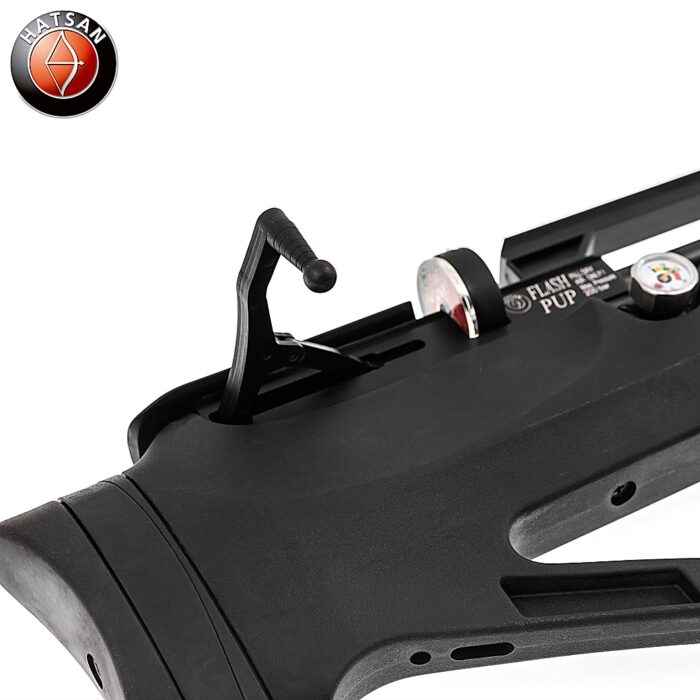
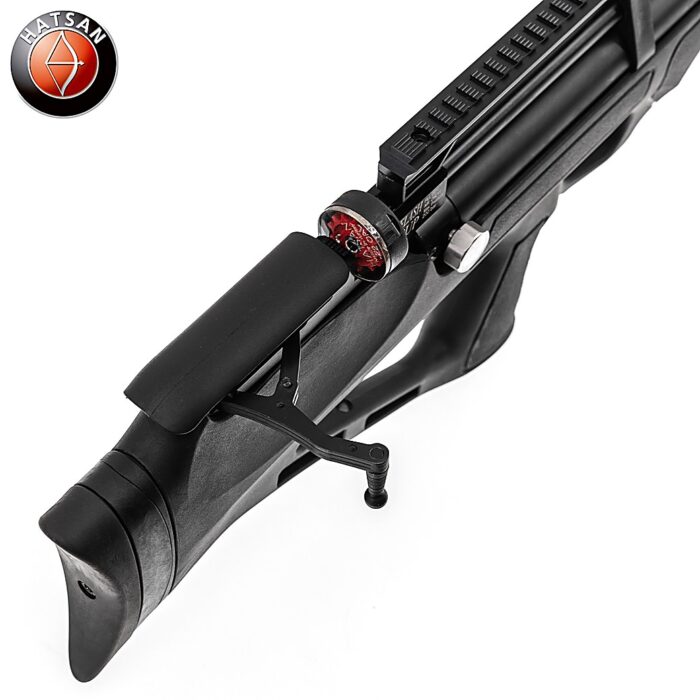


Hatsan FlashPup S PCP Air Rifle
€295.00
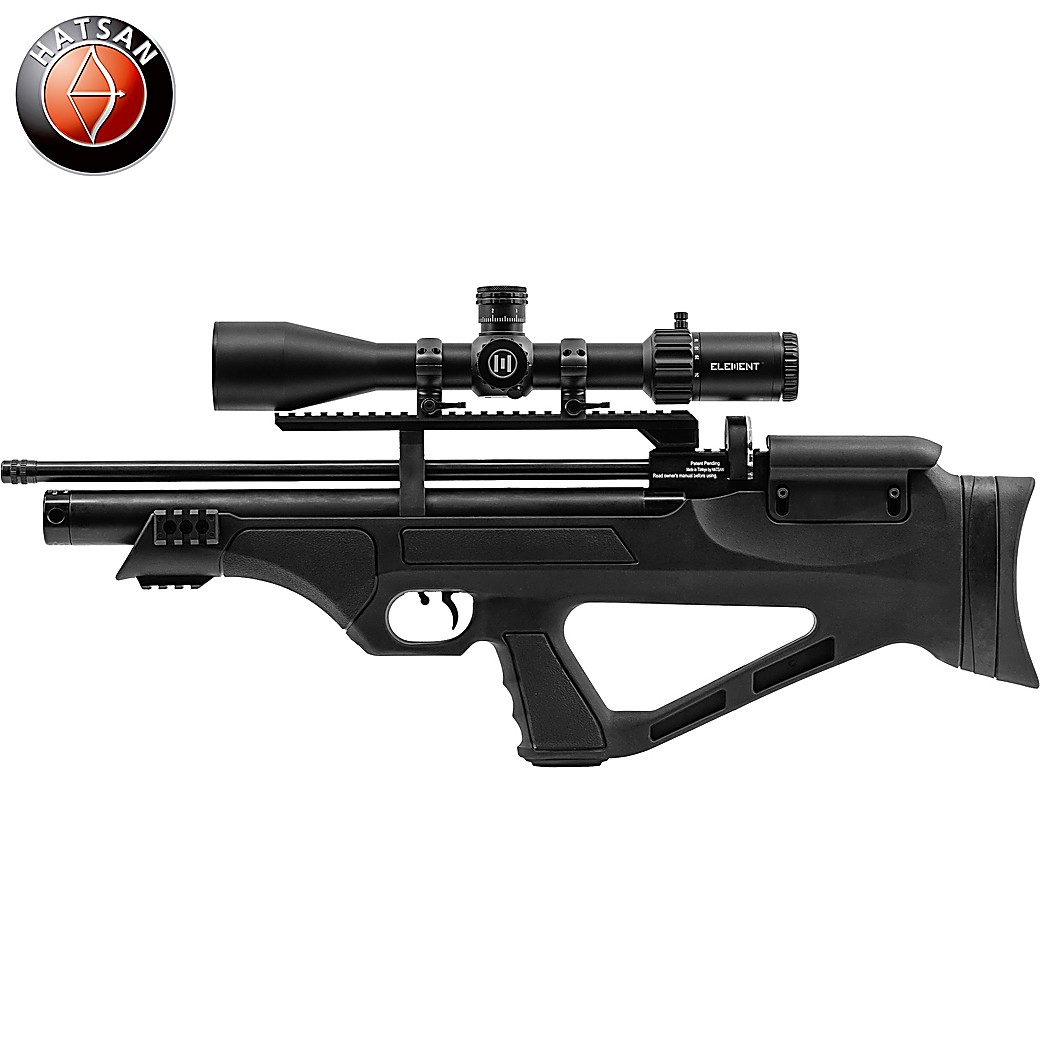
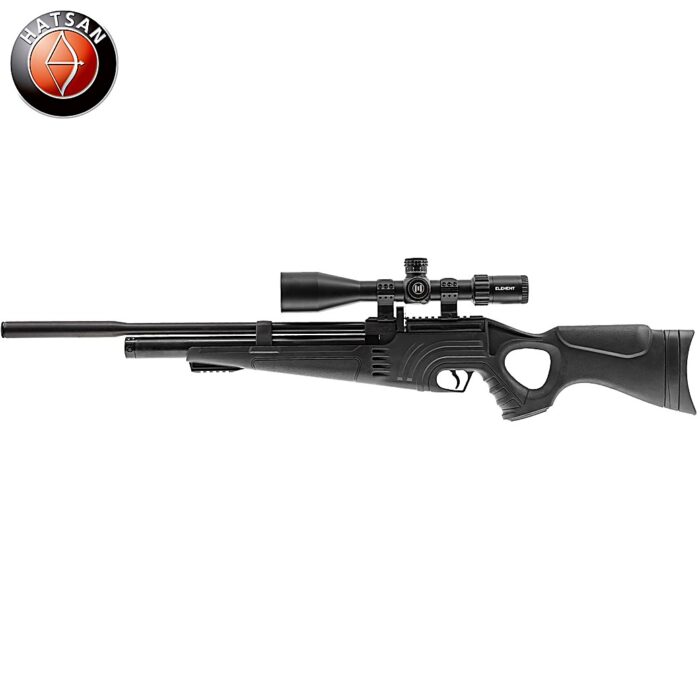
The Hatsan FlashPup S PCP air rifle is a compact and powerful Bullpup.
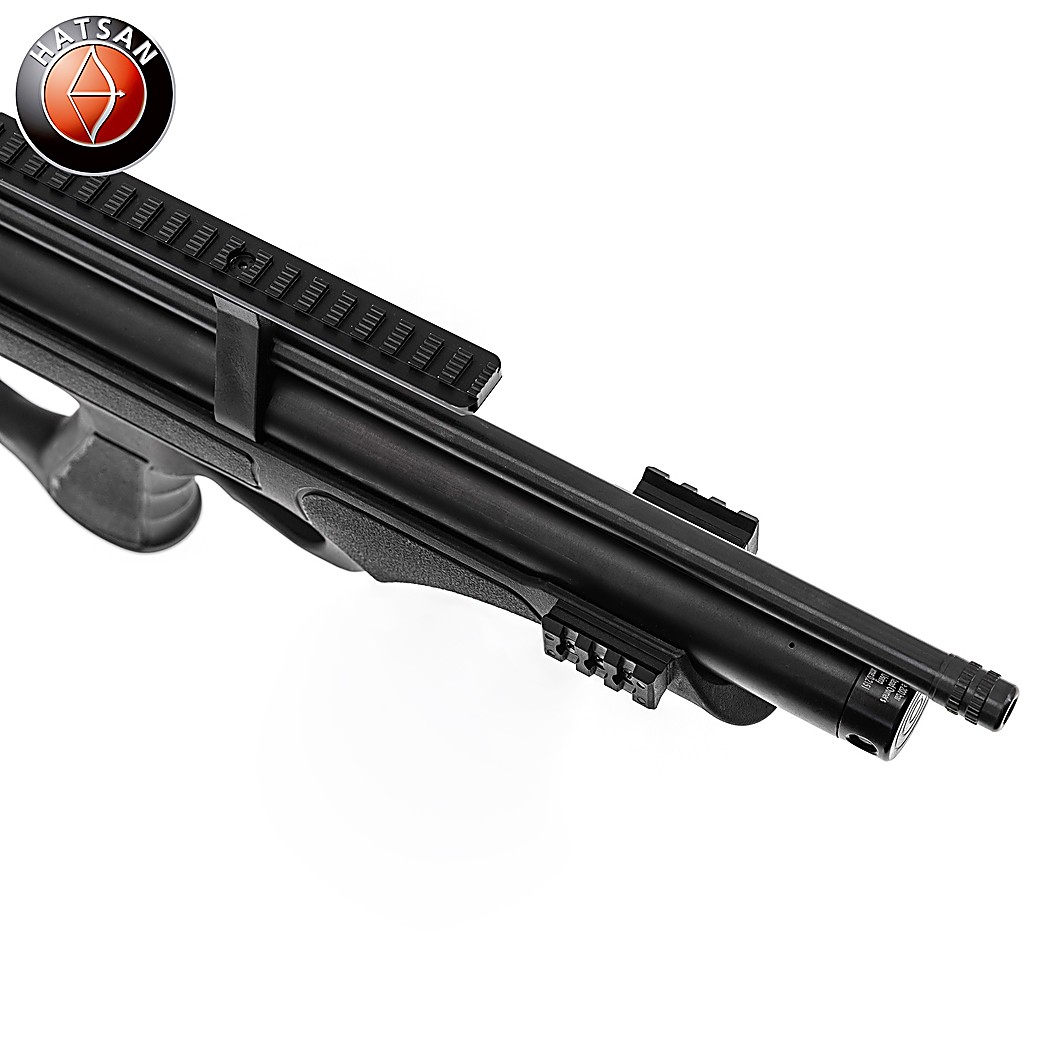
It features a synthetic stock and manual lateral bolt loading side lever system. The rifle includes a steel barrel with a thread for sound moderators. The ambidextrous stock and adjustable cheek piece provide comfort and customization. A Picatinny rail allows for easy mounting of various optical accessories. Combining precision, power, and usability, the FlashPup is suitable for a range of shooting activities.
Providing big power in a small package, Hatsan’s FlashPup S is the bullpup of choice.
Hatsan FlashPup S PCP Air Rifle – Compact Bullpup PCP Performance, Precision and Practical Handling
The Hatsan FlashPup S PCP Air Rifle combines compact bullpup ergonomics with a manually operated sidelever, multi-shot magazine system, precision-rifled barrel and lightweight synthetic stock.
Its design is especially appealing to shooters who want a full-length barrel without carrying the overall length associated with a conventional rifle.
By moving the action farther toward the rear, the bullpup layout allows the FlashPup S to use a 450mm / 17.7-inch barrel while keeping overall length to approximately 645mm / 25.4 inches.
Current factory specifications list three calibre choices:
- .177 / 4.5mm
- .22 / 5.5mm
- .25 / 6.35mm
Magazine capacity varies accordingly:
- 14 rounds in .177
- 12 rounds in .22
- 10 rounds in .25
The rifle uses a 165cc air cylinder with a maximum 200-bar fill pressure, while its average weight is approximately 3kg / 6.6lb.
Factory-listed maximum velocities are approximately 1070 fps in .177, 970 fps in .22 and 870 fps in .25, although actual velocity can vary with pellet weight, pellet shape, temperature and other conditions.
Compact Bullpup Configuration
The defining feature of the rifle is its short bullpup architecture.
Instead of placing the action ahead of the trigger like a traditional rifle, the action sits farther toward the rear.
This preserves useful barrel length while substantially reducing overall dimensions.
As a result, the rifle can feel easier to maneuver in confined range positions and more convenient to transport.
450mm Precision-Rifled and Choked Barrel
The barrel is both precision rifled and choked.
Rifling stabilizes the pellet during flight, while the choked section helps support a consistent pellet release at the muzzle.
However, actual group quality still depends on suitable pellets, optic alignment, pressure consistency and shooter technique.
Sidelever Action
The rifle uses a manually operated sidelever.
This allows the shooter to chamber each successive pellet from the rotary magazine while maintaining a relatively consistent shoulder position.
A smooth sidelever cycle can make repeated target shooting more efficient.
165cc Air Cylinder
The standard version uses a 165cc air cylinder.
Although smaller than the reservoirs found on some larger PCP rifles, it contributes to the compact dimensions and manageable weight of the platform.
200-Bar Fill Pressure
The cylinder is charged to a maximum working pressure of 200 bar.
Only filling equipment designed for high-pressure PCP use should be connected.
The maximum pressure should never be exceeded.
Shot Count
Factory figures list approximately:
- 100 total shots in .177
- 95 total shots in .22
- 90 total shots in .25
Hatsan additionally lists approximately 48, 40 and 38 shots at optimal velocity respectively.
Quattro Trigger
The rifle incorporates Hatsan’s adjustable two-stage Quattro Trigger system.
Trigger travel and trigger load can be adjusted within the manufacturer’s intended operating range.
A predictable trigger helps minimize unwanted movement during the shot.
Adjustable Cheekpiece
The synthetic stock includes an elevation-adjustable cheekpiece.
This helps the shooter align the eye naturally behind an optic.
Consistent head placement can contribute significantly to repeatable shooting.
Adjustable Butt Pad
The butt pad provides elevation and cast adjustment.
That additional fitting capability makes it easier to adapt the rifle to different shoulder positions and body proportions.
Combination Optics Rail
The receiver accommodates common 11mm and 22mm optic mounting systems.
Since the rifle is not supplied with conventional open sights, a suitable rail-mounted optic is normally used.
CARABINA HATSAN PCP BT65 SB ELITE
The CARABINA HATSAN PCP BT65 SB ELITE represents a larger conventional PCP platform.
Compared with the compact FlashPup S, the BT65 emphasizes a more traditional rifle layout and greater physical size.
hatsan air rifle
A hatsan air rifle can range from simple break-barrel designs to advanced PCP platforms.
The FlashPup S belongs to the compact bullpup side of the manufacturer’s pneumatic range.
hatsan sortie
The hatsan sortie uses semi-automatic PCP operation.
The FlashPup S instead relies on manual sidelever cycling between shots.
hatsan velox
The hatsan velox represents another modern pneumatic platform.
Its operating system and dimensions differ from the compact FlashPup S.
hatsan jet 2
The hatsan jet 2 is even smaller and more modular.
The FlashPup S retains a full rifle barrel and dedicated bullpup shoulder stock.
hatsan model 95
The hatsan model 95 is a traditional break-barrel air rifle.
It does not require external high-pressure filling equipment.
hatsan flash
The hatsan flash shares much of the basic PCP concept but uses a conventional stock rather than the rearward bullpup arrangement.
hatsanusa
Searches for hatsanusa commonly relate to Hatsan products and support within the United States.
Market specifications can differ by region.
hatsan usa
hatsan usa customers should confirm the exact configuration, power level and legal requirements applicable to their location.
hatsan harpoon
The hatsan harpoon is a specialized compressed-air launcher rather than a conventional pellet rifle.
hatsan mod 95
The hatsan mod 95 provides spring-powered break-barrel operation and therefore differs fundamentally from this PCP system.
hatsan sortie tact
The hatsan sortie tact combines compact tactical dimensions with semi-automatic operation.
The FlashPup S provides compactness through its bullpup design while retaining a manual sidelever.
hatsan hercules
The hatsan hercules family focuses on greater reservoir capacity and larger high-output PCP configurations.
The FlashPup S is substantially lighter and more compact.
hatsan piledriver
The hatsan piledriver belongs to the large-bore PCP category.
Its design goals are very different from the smaller-calibre FlashPup S.
hatsan sortie tact semi-auto pcp
The hatsan sortie tact semi-auto pcp emphasizes rapid follow-up capability.
The FlashPup S prioritizes controlled manual operation.
hatsan 135
The hatsan 135 is a break-barrel rifle rather than a pre-charged pneumatic platform.
hatsan jet
The hatsan jet is designed around portability and modularity.
The FlashPup S provides a more traditional shoulder-fired rifle experience within a compact package.
hatsan bullboss
The hatsan bullboss is another bullpup PCP.
The FlashPup S is lighter and follows the compact Flash platform concept.
hatsan 95
The hatsan 95 offers spring-powered simplicity for shooters who do not want to manage compressed-air filling equipment.
hatsan
hatsan manufactures spring, gas-piston and PCP airguns across a wide range of configurations.
The FlashPup S demonstrates the company’s compact bullpup PCP approach.
hatsan refurbished
A hatsan refurbished rifle should be assessed for pressure retention, seal condition, barrel condition, magazine function and service history.
hatsan hercules bully
The hatsan hercules bully combines bullpup architecture with considerably greater air capacity and overall mass.
The FlashPup S provides a lighter alternative.
hatsan airtact air rifle
The hatsan airtact air rifle uses a break-barrel system and represents a simpler airgun format.
hatsan invader
The hatsan invader uses a semi-automatic PCP action.
The FlashPup S instead uses a manually operated sidelever.
hatsan flashpup qe
The hatsan flashpup qe combines the FlashPup platform with Hatsan’s fully shrouded QuietEnergy barrel system.
The standard FlashPup S is shorter, while the QE configuration extends overall length.
hatsan neutron star
The hatsan neutron star represents another model within Hatsan’s wider PCP lineup.
Specifications should always be checked against the exact product rather than transferred between models.
hatsan mod 25
The hatsan mod 25 is a compact air pistol rather than a PCP rifle.
hassan blitz
Searches for hassan blitz generally refer to the Hatsan Blitz.
That model emphasizes rapid selectable operation in markets where permitted, whereas the FlashPup S uses manual sidelever cycling.
air pellet gun
As an air pellet gun, the FlashPup S uses clean compressed air rather than firearm cartridges.
A secure backstop and strict muzzle discipline remain essential.
co2 pellet rifle
A co2 pellet rifle uses carbon dioxide cartridges or cylinders.
The FlashPup S instead uses high-pressure compressed air stored in its PCP reservoir.
hercules bully air rifle
The hercules bully air rifle provides another bullpup configuration with significantly larger air capacity.
hatsan sortie threaded adapter
A hatsan sortie threaded adapter is model-specific equipment and should not automatically be assumed compatible with the FlashPup S.
h&n field target trophy
The h&n field target trophy is a popular domed pellet family.
Whether it performs well depends on calibre, individual barrel characteristics and controlled testing.
hatsan bt65.25 specifications
Searches for hatsan bt65.25 specifications concern the .25-calibre BT65.
Those figures should not be transferred to the FlashPup S.
hatsan jet i pcp .22 caliber pellet rifle kit
The hatsan jet i pcp .22 caliber pellet rifle kit provides a smaller modular PCP configuration.
The FlashPup S offers a dedicated bullpup rifle format and longer barrel.
model 95
The model 95 remains a straightforward break-barrel choice for shooters who do not require PCP equipment.
Snowpeak PP750L PCP Air Pistol
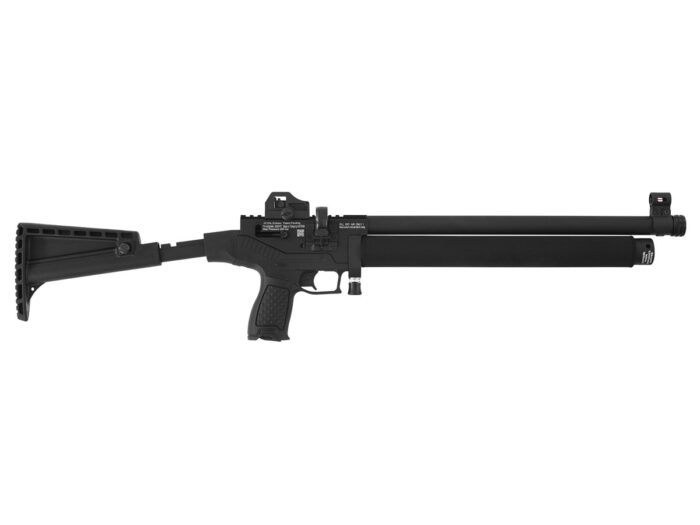
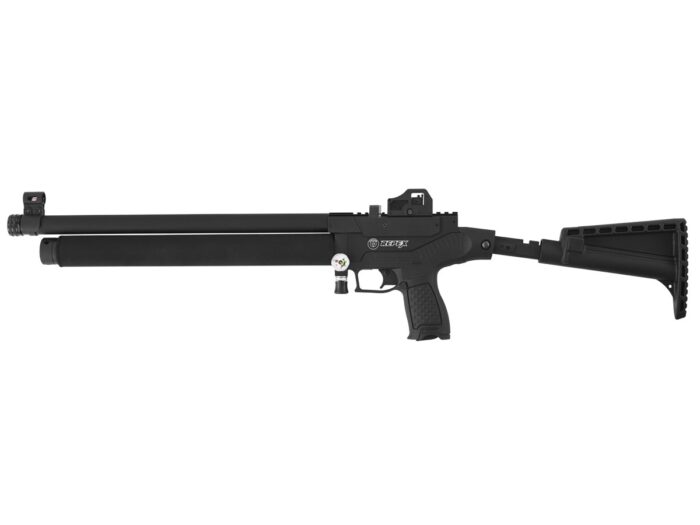
The Snowpeak PP750L PCP Air Pistol is a compact pneumatic pistol/carbine platform from another manufacturer.
It is considerably smaller than the FlashPup S.
snowpeak airguns
snowpeak airguns include PCP rifles, pistols and bullpup platforms that can be compared with Hatsan products.
snowpeak sports
Searches for snowpeak sports commonly relate to Snowpeak airgun products and sporting equipment.
snowpeak ap900
The snowpeak ap900 belongs to another airgun platform family and should be evaluated using its own specifications.
snowpeak max
The phrase snowpeak max may refer to different Snowpeak products depending on the market.
snowpeak pp750
The snowpeak pp750 emphasizes compact PCP dimensions.
The FlashPup S provides a fuller rifle-style bullpup platform.
pp750
The pp750 can appeal to shooters who prioritize extreme portability.
The FlashPup S instead balances compact dimensions with conventional rifle handling.
snowpeak p35x
The snowpeak p35x also uses a bullpup concept.
Its dimensions, air system and operating characteristics should be compared independently.
pr900 gen 3
The pr900 gen 3 represents a simpler lightweight PCP platform.
The FlashPup S offers a shorter bullpup arrangement and greater ergonomic adjustment.
snow peak pp750
The snow peak pp750 is another common search variation for the compact PP750 platform.
snowpeak p35
The snowpeak p35 uses bullpup architecture, making it another compact PCP alternative.
snowpeak m60b
The snowpeak m60b represents another modern PCP rifle and should be compared through exact model specifications.
snow peak pp20
The snow peak pp20 is an air-pistol platform rather than a dedicated bullpup rifle.
p35
The p35 is associated with a compact Snowpeak bullpup design.
p35x
The p35x continues the compact bullpup concept and offers a different balance from the FlashPup S.
p35x pcp
A p35x pcp is designed around compact dimensions, while the FlashPup S combines compactness with Hatsan’s sidelever and stock architecture.
snowpeak m25
The snowpeak m25 represents another PCP rifle choice and should be compared by verified model-specific information.
ap900b pcp air rifle
The ap900b pcp air rifle belongs to another pneumatic range and follows a different design philosophy.
snowpeak m60
The snowpeak m60 is another PCP option for buyers comparing handling, capacity, action design and overall dimensions.
Why the FlashPup S Stands Out
The strongest advantage of the FlashPup S is its ability to combine a full 450mm barrel with an overall length of only about 645mm.
That provides a practical balance between compact handling and useful barrel length.
The rifle also weighs only around 3kg, making it substantially easier to carry than many large tactical PCP rifles.
Why the Bullpup Format Works Well
Moving the action rearward keeps the overall package short.
This can be useful during bench shooting, storage and transport.
It also shifts more of the rifle’s mass closer to the shooter.
How the PCP System Supports Precision
The firing cycle lacks the large moving piston found in spring-powered rifles.
As a result, mechanical movement during firing is reduced.
That can make it easier to maintain sight alignment and follow-through.
Why Pellet Selection Matters
Different barrels can prefer different pellets.
Weight matters.
Head size matters.
Skirt condition matters.
Manufacturing consistency matters.
Rather than selecting ammunition solely by advertised velocity, shooters should compare actual group size under controlled conditions.
Where the Rifle Performs Best
The FlashPup S is particularly well suited to lawful controlled target environments.
Its short overall length can make it comfortable from:
A bench.
A seated position.
A kneeling position.
A supported standing position.
A suitable backstop should always be used.
When This Rifle Makes Sense
The platform makes particular sense when the shooter wants:
A compact PCP rifle.
A bullpup stock.
A full-length 450mm barrel.
A manageable 3kg weight.
Multi-shot magazines.
A two-stage adjustable trigger.
An adjustable cheekpiece.
A 200-bar air system.
Three calibre options.
An optic-ready receiver.
Why the Adjustable Stock Features Matter
Different shooters have different body proportions.
An adjustable cheekpiece helps establish proper eye alignment behind a scope.
Meanwhile, the adjustable butt pad makes shoulder positioning more comfortable.
Better fit can contribute to repeatability.
Why the Magazine System Matters
The magazine reduces the need to load a pellet individually for every shot.
This allows the shooter to maintain a more consistent shooting rhythm.
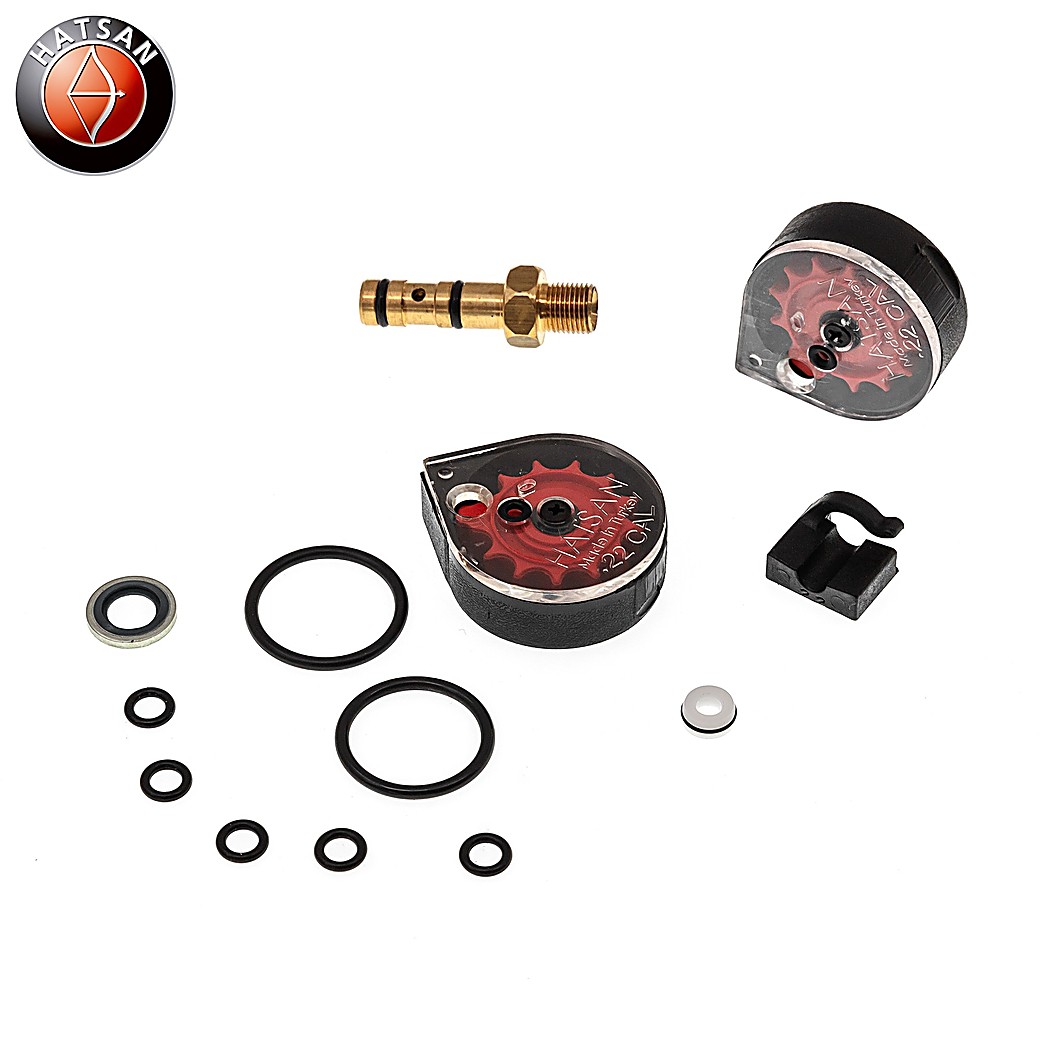
Two magazines and a quick-fill nozzle are listed among current factory equipment.
Why the Pressure Gauge Is Important
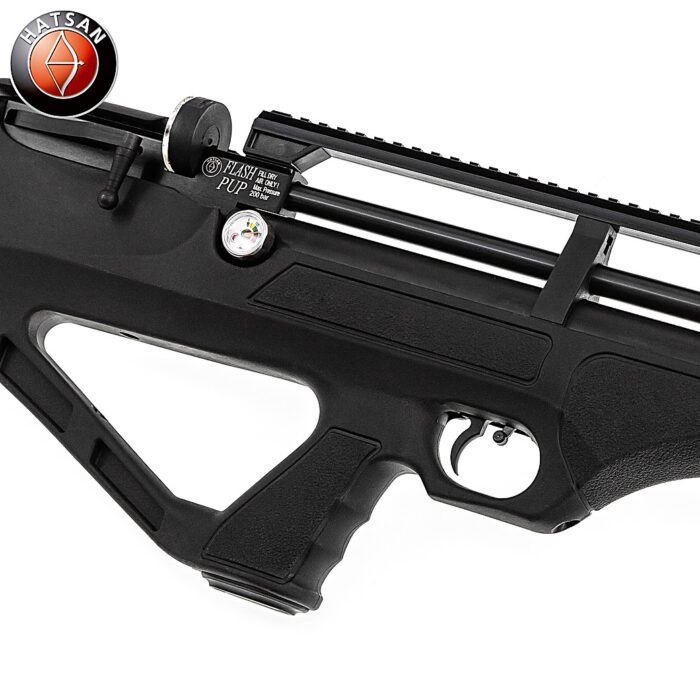
The built-in gauge helps the shooter monitor remaining air.
This removes much of the guesswork associated with estimating reservoir status by shot count alone.
Why Shot Count Should Be Viewed Practically
Factory figures are useful reference points.
However, environmental conditions and ammunition can affect real results.
The most valuable part of a fill is usually the range in which velocity and point of impact remain consistent.
Optics and Sight Setup
The rifle does not rely on traditional open sights.
A suitable scope or other compatible optic can be mounted on the receiver rail.
Good mounts are important because poor mounting can cause shifting groups even when the rifle itself is performing correctly.
Practical Precision
Real-world precision comes from the relationship between:
The barrel.
The pellet.
Air pressure.
The optic.
The trigger.
The shooter.
A stable setup with suitable ammunition can provide far better results than simply chasing maximum velocity.
Maintenance Considerations
Routine maintenance should remain straightforward.
Keep the exterior clean.
Protect the fill port.
Monitor pressure retention.
Inspect magazines.
Keep optic mounts secure.
Address leaks promptly.
Avoid unnecessary internal disassembly.
High-Pressure Safety
Hatsan specifically warns that PCP rifles contain pressurized air and should not be dismantled while charged except by competent service personnel.
The manufacturer also specifies clean, dry compressed air rather than other gases.
Local Power and Licensing Requirements
Factory output figures do not necessarily represent versions sold in every jurisdiction.
Some markets regulate muzzle energy.
Others regulate velocity, calibre, ownership or licensing.
Buyers should verify their local requirements before purchase or use.
Final Section 1 Assessment
The Hatsan FlashPup S PCP Air Rifle is a compact bullpup designed to provide practical PCP performance without the size and weight of many larger pneumatic rifles.
Its core configuration combines a 450mm precision-rifled and choked barrel, 165cc air cylinder, 200-bar maximum fill pressure, sidelever action, adjustable Quattro Trigger, synthetic ambidextrous bullpup stock and adjustable cheekpiece.
Available in .177, .22 and .25, it provides magazine capacities of 14, 12 and 10 rounds respectively.
At approximately 645mm overall length and 3kg average weight, the rifle is especially notable for packing a full 450mm barrel into a highly compact format.
For shooters who want a short, manageable PCP with multi-shot convenience and familiar Hatsan controls, the FlashPup S provides a balanced platform.
Its best performance comes from quality pellets, correct optic setup, careful pressure management, consistent shooting technique and routine maintenance rather than simply pursuing maximum velocity.
Section 2 – Practical Accuracy, Bullpup Handling, Air Management, Optics, Maintenance and Ownership
Understanding the Rifle as a Compact PCP Platform
The FlashPup S is best understood as a compact bullpup PCP designed to combine manageable weight, useful air capacity, multi-shot operation and a full-length barrel within a short overall package.
Its performance depends on several systems working together.
The barrel matters.
The air reservoir matters.
The trigger matters.
The magazine matters.
The stock matters.
The optic matters.
The pellet matters.
The shooter matters.
When each of these elements is matched properly, the rifle can provide a stable and repeatable shooting experience for lawful target practice and recreational range use.
Why the Bullpup Layout Matters
The bullpup configuration moves the action farther toward the rear of the rifle.
That allows the barrel to remain relatively long without requiring the overall rifle to become excessively long.
This design can be especially useful for shooters who prefer compact handling but do not want to sacrifice barrel length.
Compact Size and Practical Handling
A shorter overall rifle can feel easier to manage in confined shooting positions.
It can also be easier to transport and store.
Compared with a conventional rifle using a similar barrel length, the bullpup arrangement keeps more of the rifle closer to the shooter.
Balance Near the Shoulder
Because the action is positioned farther rearward, the balance can feel different from a conventional rifle.
More of the rifle’s weight is concentrated closer to the shoulder.
This can make the platform feel shorter and more centered even though it still uses a full-length barrel.
Why Weight Matters
The rifle remains relatively manageable compared with many larger PCP platforms.
This can make it more comfortable during standing, kneeling and seated shooting.
However, adding a heavy optic, bipod or other accessories can change the balance significantly.
Keep the Setup Practical
A compact rifle can lose some of its handling advantage if too much heavy equipment is added.
Accessories should serve a clear purpose.
A practical setup usually gives better balance than a heavily equipped one.
The PCP Firing Cycle
A pre-charged pneumatic system stores compressed air in the reservoir.
When the trigger is operated, a controlled amount of air is released to propel the pellet.
Because there is no large spring piston moving inside the rifle, the firing cycle generally feels smoother than a spring-powered design.
Reduced Mechanical Movement
Less internal movement can help the shooter maintain:
Sight alignment.
Cheek position.
Trigger control.
Shoulder contact.
Follow-through.
Good technique is still essential, but a PCP platform removes some of the mechanical disturbance that can make spring rifles more demanding.
Reservoir Capacity
The rifle uses a relatively compact air reservoir.
Its size contributes to the rifle’s short and lightweight character.
The trade-off is that it may require more frequent refilling than a very large-bottle PCP.
Why Smaller Capacity Is Not Always a Disadvantage
A smaller reservoir can make the rifle lighter.
It can also keep the overall platform better balanced.
For many recreational range sessions, a moderate shot count is sufficient.
The best air capacity depends on how the shooter actually uses the rifle.
Monitoring Air Pressure
The built-in gauge should be checked before and during a shooting session.
Estimated shot count is useful, but the gauge provides a clearer indication of remaining air.
Learning the Useful Pressure Range
Each rifle can behave slightly differently.
The shooter should learn the pressure range where velocity and point of impact remain most consistent.
This helps determine when to refill.
High-Pressure Filling
Only filling equipment rated for PCP use should be connected.
Possible filling sources include:
A suitable hand pump.
A rated dive cylinder.
A carbon-fiber fill tank.
A purpose-built PCP compressor.
The connection system should be clean and compatible.
Filling Slowly
A slow fill is generally easier to control.
Rapid filling generates heat.
A controlled fill gives the shooter more time to monitor pressure and reduces unnecessary thermal stress.
Avoiding Overfilling
The reservoir should never be filled above the manufacturer’s stated maximum.
More pressure does not automatically create better performance.
Overfilling can place unnecessary stress on seals and components.
Clean, Dry Air
Clean air helps protect the pneumatic system.
Moisture and dirt can affect seals and internal parts over time.
The fill connection should remain clean.
Temperature Effects
Reservoir pressure changes with temperature.
A warm rifle may show a slightly different pressure from the same rifle after cooling.
This is normal.
The rifle should never be heated deliberately to increase pressure.
Sidelever Operation
The sidelever provides a smooth method of loading the next pellet from the magazine.
It should be cycled deliberately.
Excessive force is unnecessary.
Why Smooth Cycling Matters
Smooth lever operation reduces unnecessary movement between shots.
This helps maintain a consistent position behind the rifle.
It can also reduce stress on the magazine and feeding mechanism.
When the Action Feels Unusual
If the lever becomes unusually stiff, stop and check the rifle safely.
Possible causes include:
A damaged pellet.
Magazine misalignment.
Debris.
Wear.
A mechanical problem.
The action should not be forced.
Magazine Convenience
The rotary magazine allows multiple shots before reloading.
This helps maintain rhythm during target sessions.
It is particularly useful when testing groups because the shooter can concentrate on technique rather than repeatedly loading individual pellets.
Magazine Inspection
The magazine should be checked for:
Cracks.
Debris.
Uneven rotation.
Damaged indexing components.
Pellet fit.
Wear.
A damaged magazine can create feeding problems.
Loading Pellets Carefully
Pellets should be loaded without damaging their skirts or heads.
A bent pellet can feed poorly and produce inconsistent accuracy.
For careful target testing, damaged pellets should be discarded.
Pellet Quality
Pellet quality can make a major difference.
Important characteristics include:
Weight consistency.
Head diameter.
Skirt condition.
Surface finish.
Manufacturing quality.
A precision barrel cannot compensate completely for badly made ammunition.
Testing Different Pellets
The best pellet should be found through controlled shooting.
Keep the same:
Distance.
Air-pressure range.
Optic.
Rest.
Target.
Shooting position.
Then compare group sizes.
Why the Fastest Pellet May Not Be Best
A very light pellet may produce a high velocity.
However, higher speed does not guarantee better accuracy.
A slower pellet may produce a tighter and more repeatable group.
Practical Accuracy
Practical accuracy is created by the relationship between the rifle, ammunition, optic and shooter.
The barrel provides the mechanical foundation.
The rest of the system determines whether that potential is realized.
Barrel Care
The barrel should be protected from impact and contamination.
The muzzle area deserves particular care.
Damage near the crown can affect the way the pellet leaves the barrel.
Cleaning the Barrel
Aggressive or frequent cleaning is generally unnecessary.
Cleaning should be done only when there is a reason.
Improper rods or abrasive tools can damage the bore.
When Cleaning May Be Helpful
Cleaning may be considered when:
Accuracy suddenly deteriorates.
Contamination is suspected.
The rifle has been stored for a long time.
A technician recommends it.
A new pellet produces unusual results.
Trigger Control
A predictable trigger is essential for good shooting.
The shooter should become familiar with:
First-stage movement.
Break point.
Reset.
Pull weight.
Finger placement.
Smooth Trigger Press
The trigger should be pressed smoothly.
A sudden pull can disturb the sight picture.
The goal is to release the shot without moving the rifle unnecessarily.
Trigger Finger Position
The finger should meet the trigger naturally.
An awkward position can create sideways pressure.
A comfortable position usually improves repeatability.
Safe Trigger Discipline
The trigger should only be touched when the rifle is pointed safely and the shooter intends to fire.
The safety should never replace proper muzzle control.
Cheekpiece Adjustment
A correct cheekpiece height helps the eye align naturally with the optic.
The shooter should be able to shoulder the rifle and immediately see through the scope without searching for the sight picture.
Why Repeatable Head Position Matters
Changing the head position from shot to shot can alter the apparent sight picture.
A consistent cheek weld supports repeatable aiming.
Butt Pad Adjustment
The adjustable butt pad can help improve shoulder contact.
A good fit reduces unnecessary movement and makes the rifle more comfortable.
Stock Fit
The rifle should fit the shooter rather than forcing the shooter into an awkward position.
Comfort improves consistency.
Grip Position
The firing hand should remain relaxed but secure.
Excessive grip pressure can create tension.
The thumbhole layout helps provide a stable hand position.
Support-Hand Position
The support hand should be placed consistently.
A relaxed but controlled grip is usually preferable to excessive pressure.
Benchrest Shooting
A stable bench is one of the best environments for evaluating the rifle.
It reduces shooter movement and makes it easier to compare ammunition.
Front Rest Placement
The front rest should support the rifle without interfering with the reservoir, magazine or controls.
Rear Support
A rear support can help stabilize elevation.
Small adjustments can then be made more precisely.
Standing Shooting
Standing shooting is more demanding.
The rifle’s manageable weight makes it easier than some larger PCPs.
The shooter should still avoid holding the rifle on target for too long.
Kneeling Position
Kneeling provides more stability than standing.
The compact bullpup layout can feel natural in this position.
Seated Position
A seated position can provide a good balance between comfort and control.
This can be useful during longer informal sessions.
Optic Selection
The rifle is typically used with an optic.
A suitable scope should match the intended distance.
Useful features include:
Clear glass.
Reliable adjustments.
Correct eye relief.
Appropriate magnification.
Strong mounts.
A practical reticle.
Avoiding Excessive Magnification
Very high magnification is not always necessary.
It can make small movements appear larger and reduce field of view.
The best level depends on distance and target size.
Scope Mount Security
Mounts should remain tight.
Loose mounts can create shifting groups and unexplained zero changes.
They should be checked periodically.
Scope Height
The optic should sit at a height that works with the cheekpiece.
Good head position is more important than mounting the scope as low or as high as possible.
Zeroing
Zeroing should be carried out at a controlled range.
Use:
A known distance.
A secure backstop.
A stable position.
Consistent pellets.
Small optic adjustments.
Once established, record the settings.
Confirming Zero
Zero should be checked after:
Transport.
Impact.
Optic removal.
Mount adjustment.
Maintenance.
Changing pellet type.
Why Group Size Matters
A single accurate shot proves very little.
The important measure is whether the rifle can place repeated shots into a consistent group.
Group testing gives more useful information.
Shooting Logs
A simple shooting log can help track performance.
Record:
Distance.
Pellet type.
Starting pressure.
Ending pressure.
Group size.
Weather.
Optic setting.
Why Records Are Useful
Written information makes comparison more objective.
It helps identify what works best with the individual rifle.
Chronograph Use
A chronograph can be useful for lawful performance monitoring.
It can show:
Velocity consistency.
Changes through the air charge.
Ammunition variation.
Possible seal problems.
Potential maintenance needs.
Consistency Over Maximum Output
For target use, consistency is usually more useful than maximum velocity.
Predictable performance helps produce predictable point of impact.
Range Use
A formal range provides controlled conditions.
Known distances and proper backstops make testing easier.
Private Target Areas
Where legally permitted, private target areas should be carefully planned.
Consider:
Roads.
Buildings.
Animals.
People.
Property boundaries.
Terrain.
A secure backstop is essential.
Backstop Quality
The backstop should stop pellets safely.
It should be larger than the target area.
The shooter should always know what lies behind it.
Eye Protection
Appropriate eye protection is recommended.
Ricochets and fragments can occur even during routine air-rifle shooting.
Exterior Cleaning
After shooting, wipe the rifle with a soft cloth.
Remove dust and moisture.
Keep controls and moving areas clean.
Fill Port Care
The fill connection should remain free of dirt.
Contamination can affect seals.
Protective caps should be used where provided.
Seal Condition
Signs of seal problems may include:
Unexpected pressure loss.
Audible leakage.
Reduced shot count.
Difficulty holding pressure.
Inconsistent performance.
Persistent leaks should be serviced.
Pressure Loss During Storage
A small pressure change may result from temperature.
Continuous or substantial loss can indicate leakage.
The rifle should be inspected if the pressure drops repeatedly without use.
Avoiding Unnecessary Disassembly
The high-pressure air system should not be opened casually.
Internal repairs should be carried out according to manufacturer guidance by someone qualified to work on PCP systems.
Long-Term Storage
The rifle should be stored:
Dry.
Secure.
Away from children.
Away from excessive heat.
Away from chemicals.
Away from direct sunlight.
The manufacturer’s guidance should be followed regarding reservoir pressure during extended storage.
Magazine Storage
Magazines should be stored clean and dry.
Damaged pellets should not be left inside.
A protective container can help keep dirt away.
Transport
During transport, the rifle should be unloaded and secured.
The magazine should be removed where appropriate.
The rifle should be protected from impact.
Local transport regulations should be followed.
Documentation
Keep:
The owner manual.
Serial number.
Purchase records.
Warranty information.
Service history.
Pellet-testing notes.
Chronograph data.
Good documentation simplifies future maintenance.
Buying Used
A used rifle should be checked carefully.
Inspect:
Reservoir condition.
Pressure gauge.
Seals.
Barrel.
Stock.
Magazine function.
Trigger.
Safety.
Sidelever.
Fill port.
Optic rail.
Any modifications.
Questions for a Seller
Useful questions include:
Does it hold pressure?
Has it been serviced?
Are all magazines included?
Has the reservoir been damaged?
Has the rifle been modified?
What pellets perform well?
Are there known leaks?
Ownership Costs
PCP ownership includes more than the rifle itself.
Possible expenses include:
Filling equipment.
Pellets.
Scopes.
Mounts.
Replacement seals.
Magazines.
Professional service.
Range fees.
Storage equipment.
Why Filling Access Matters
The rifle is much easier to own when the user has reliable access to high-pressure air.
A hand pump may suit occasional use.
A tank or compressor may be more practical for frequent shooting.
Why the Compact Platform Appeals to Many Shooters
The rifle offers a useful combination of:
Short overall length.
Manageable weight.
Full-length barrel.
Multi-shot convenience.
Adjustable stock components.
A straightforward sidelever.
A PCP firing cycle.
These features make it versatile.
Who May Prefer a Larger PCP
A shooter who wants:
Much larger air capacity.
Very long shot strings.
A heavy benchrest chassis.
Extensive external adjustment.
may prefer a larger platform.
The FlashPup S is strongest when compact handling is the priority.
Who May Prefer a Simpler Rifle
Someone who does not want to manage compressed-air filling equipment may prefer a spring-powered rifle.
PCP ownership requires additional support equipment.
Routine Inspection
Regularly inspect:
Reservoir.
Pressure gauge.
Fill port.
Magazine.
Sidelever.
Trigger.
Safety.
Optic mounts.
Visible seals.
Small problems are easier to address early.
Preventive Maintenance
The rifle usually benefits more from simple maintenance than frequent disassembly.
Keep it clean.
Use good pellets.
Monitor air pressure.
Protect the fill connection.
Keep mounts tight.
Address leaks promptly.
Troubleshooting Accuracy Problems
If groups suddenly become larger, check simple causes first.
Review:
Pellet condition.
Air pressure.
Scope mounts.
Optic zero.
Magazine condition.
Wind.
Shooting position.
Barrel condition.
Change one factor at a time.
Troubleshooting Feeding Problems
If the action does not feed smoothly:
Stop safely.
Remove the magazine.
Inspect the pellets.
Check magazine condition.
Look for debris.
Do not force the sidelever.
Troubleshooting Air Loss
If pressure falls unexpectedly:
Observe the gauge.
Listen for leaks.
Check the fill connection.
Inspect accessible seals.
Seek professional service if the cause is not obvious.
Why Routine Matters
A consistent routine makes the rifle easier to evaluate.
Check air pressure.
Load good pellets.
Confirm the optic.
Use the same shooting position.
Monitor the gauge.
Record results.
This creates reliable data.
Practical Accuracy Potential
A well-maintained rifle with suitable pellets can provide strong practical precision.
However, no rifle performs at its best if the optic is loose, the ammunition is inconsistent or the shooter changes technique from shot to shot.
Final Practical Assessment
The Hatsan FlashPup S is a compact PCP that combines a full-length barrel with short bullpup dimensions, manageable weight and multi-shot convenience.
Its compact architecture is one of its strongest qualities.
The sidelever is straightforward.
The magazine reduces interruptions.
The adjustable cheekpiece and butt pad help improve fit.
The onboard pressure gauge simplifies air management.
The PCP firing cycle helps reduce mechanical disturbance.
The rifle performs best when the owner focuses on consistency.
Use suitable pellets.
Maintain reservoir pressure within the useful range.
Use properly rated filling equipment.
Keep the optic secure.
Protect the barrel.
Maintain magazines.
Monitor seals.
Use a safe backstop.
Store the rifle securely.
Stay within local legal limits.
With these practices in place, the FlashPup S can provide a practical, compact and repeatable platform for lawful target shooting, controlled range practice and recreational air-rifle use.
Be the first to review “Hatsan FlashPup S PCP Air Rifle”
Related products


Hatsan
Hatsan


Hatsan

Hatsan

Hatsan
Reviews
There are no reviews yet.