
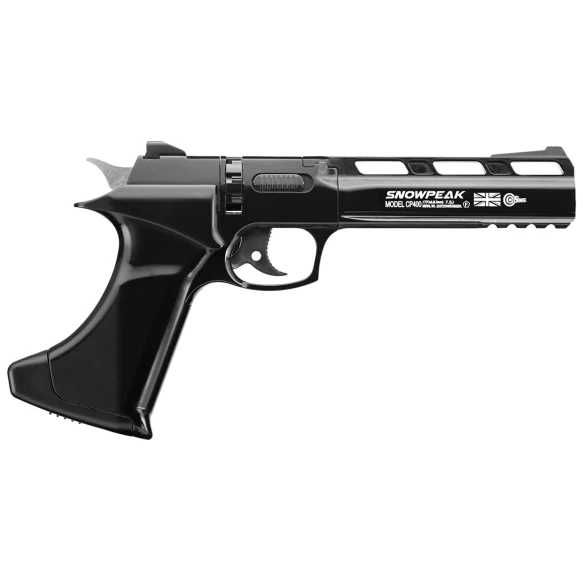
Snowpeak CP400 CO2 Air Pistol
€120.00
Snowpeak CP400 Air Pistol is relatively unique in its position in the CO2 airgun world being a multi-shot pistol in a tactical style.
| Action | Multi Shot |
|---|---|
| Calibre | .177 (4.5mm) |
| Type | CO2 powered |
| Weight | 680g |
| Length (total) | 5.7″ |
Snowpeak CP400 CO2 Air Pistol – Compact .177 Calibre Pellet Pistol with 8-Shot Rotary Magazine, Rifled Steel Barrel and Double-Action Mechanism
Snowpeak CP400 CO2 Air Pistol – Technical Specifications, Precision Engineering, Compact Construction, Recreational Target Shooting and Product Comparisons
Snowpeak CP400 CO2 Air Pistol – Modern Sporting Engineering
The Snowpeak CP400 CO2 Air Pistol combines a compact exterior with a cartridge-powered pneumatic operating system, an eight-shot rotary magazine and double-action mechanical construction.
Developed for recreational target shooting, this model offers an alternative to larger compressed-air sporting platforms.
Furthermore, the CP400 features a rifled steel barrel, manual safety and synthetic grip. Its approximately 600g manufacturer-listed weight distinguishes it from heavier sporting equipment.
Unlike pre-charged pneumatic designs, this model uses a standard 12g carbon dioxide cartridge rather than a refillable high-pressure reservoir.
Additionally, its double-action-only arrangement provides a specific mechanical configuration, while the non-blowback construction avoids a reciprocating slide mechanism.
For adults interested in lawful recreational target activities, the CP400 presents a recognizable combination of compact dimensions and established pneumatic technology.
However, accuracy and operating consistency depend on equipment condition, environmental temperature and other variables.
Consequently, prospective owners should evaluate verified specifications and appropriate maintenance requirements before purchasing.
Snowpeak CP400 CO2 Air Pistol – Technical Specifications
The manufacturer’s published specifications identify the following characteristics:
-
Manufacturer: Snowpeak
-
Model: CP400
-
Operating system: Carbon dioxide pneumatic
-
Calibre: .177 (4.5mm)
-
Power source: Standard 12g CO2 cartridge
-
Action: Double-action-only, non-blowback
-
Magazine capacity: 8 pellets
-
Magazine design: Rotary
-
Barrel length: 168mm
-
Barrel construction: Rifled steel
-
Published maximum velocity: 400 FPS
-
Trigger-pull specification: 3–9 lbf
-
Pressure regulator: None
-
Front sight: Fixed, without fibre optic
-
Safety: Manual
-
Manufacturer-listed dimensions: 250 × 32 × 150mm
-
Manufacturer-listed weight: Approximately 600g
-
Grip: Black synthetic resin
Retailers report differing velocities and external dimensions for certain versions. Therefore, buyers should verify the actual product configuration rather than combine specifications from different listings.
Why the 12g CO2 System Matters
The cartridge-powered system distinguishes this model from equipment with permanently installed compressed-air reservoirs.
Furthermore, its design avoids the need for a separate high-pressure charging system.
However, carbon dioxide responds to temperature changes, so published performance figures may vary under different environmental conditions.
Consequently, owners should follow manufacturer guidance regarding approved cartridges, temperature exposure and professional servicing.
Snowpeak Airguns – Exploring the Manufacturer’s Sporting Range
The wider snowpeak airguns, snowpeak sports and snowpeaks collections include various sporting designs.
Related product searches include snowpeak ap900, ap900b pcp air rifle, snowpeak max, snowpeak max 1 price, pr900 gen 3, snowpeak m60 and snowpeak m60b.
Furthermore, snowpeak m25, m25 rifle, m25 weapon, m50 rifle, hp300 and t rex 6000 appear in broader equipment comparisons.
These models have separate engineering characteristics and should not be confused with the CP400.
Snowpeak P35 and P35X – Alternative Sporting Configurations
Consumers researching snowpeak p35, snowpeak p35x, p35, p35x, p35x pcp and pcp p 35 encounter alternative pneumatic designs.
Additionally, snowpeak p35 vs p35x reflects interest in differences between those configurations.
However, their compressed-air systems differ from the featured cartridge-powered model.
Snowpeak PP750L PCP Air Pistol – Understanding the Differences
The Snowpeak PP750L PCP Air Pistol represents another compact sporting product.
Related searches include Snowpeak PP750L, snowpeak pp750, snow peak pp750, pp750 and Snowpeak PP750L PCP Air Pistol for sale.
Furthermore, Snowpeak Air Pistol, PCP Pistol, Airgun Pistol and High power PCP air pistol describe broader market categories.
However, the CP400 uses carbon dioxide rather than the pre-charged air system associated with those alternatives.
Snowpeak PP20 – Dedicated Precision Target Equipment
The expressions snowpeak pp20, snow peak pp20 and pistolet pcp arcea-snowpeak onix sport concern separate sporting products or regional listings.
These configurations differ in operating technology and intended sporting applications.
Consequently, their specifications should not be attributed to this model.
Daystate Delta Wolf – Premium Pneumatic Comparisons
The wider sporting market includes Daystate Delta Wolf Performance, daystate blackwolf, delta wolf, daystate delta wolf, daystate alpha wolf and daystate redwolf.
Additional searches include daystate, day state, huntsman daystate, alpha red wolf, daystate wolverine sapphire and what is a delta wolf.
These names identify separate premium sporting product families.
Their technical specifications do not describe the CP400.
Sporting Accessories and Product Compatibility
Related accessory searches include air gun accessories, air gun pc, 177 magazine, air gun suppressor, airgun moderator and puddy bottle cover.
Furthermore, day wolf m-lok to picatinny rail adapter, black snood, magpul moe si, enhanced rubber butt pad, wolf battery and how to put a gun sling on a rifle concern other products and accessories.
However, these expressions do not establish compatibility with the featured model.
Only manufacturer-approved equipment should be considered.
Snowpeak Brand Origin and Related Search Terminology
Prospective buyers may research snow peak equipment, snow peak customer service, snow peak brand origin, what is a pcp airgun and pcp pellet rifle.
Snowpeak identifies 1976 as the beginning of its manufacturing history and lists its business address in Shaoxing, Zhejiang, China.
Meanwhile, pellet 9mm, snowfall gun, how much did the m60 weigh and can wolverine go on planes concern unrelated products or topics.
These terms should not be interpreted as specifications for this compact sporting model.
Why Consider the Snowpeak CP400 CO2 Air Pistol?
The CP400 combines an eight-shot rotary magazine, double-action-only operation, a compact synthetic exterior and a cartridge-powered pneumatic system.
Furthermore, its documented .177 calibre and rifled steel barrel establish a clear technical identity.
For appropriately trained adults participating in lawful recreational target activities, the model provides a recognizable entry-level sporting configuration.
However, actual precision, reliability and regional legality must be evaluated separately.
The Snowpeak CP400 offers a practical combination of compact dimensions, traditional mechanical construction and cartridge-powered pneumatic technology for recreational target shooting.
Before purchasing, confirm the exact production version, included accessories, applicable laws and availability of qualified technical support.
Advanced Carbon Dioxide Engineering, Precision Manufacturing, Lightweight Construction, Mechanical Reliability, Ergonomic Design, Professional Maintenance and Long-Term Ownership Value
Understanding Modern Carbon Dioxide Technology
Modern carbon dioxide technology combines compressed-gas engineering with carefully manufactured mechanical components. This operating system differs from equipment that relies on rechargeable high-pressure air reservoirs because it uses a replaceable gas cartridge as its energy source.
Furthermore, the compact construction demonstrates how manufacturers can integrate pneumatic and mechanical assemblies within relatively limited dimensions.
Every component must correspond to established technical requirements, including material compatibility, sealing integrity and manufacturing tolerances.
However, cartridge-powered technology does not automatically guarantee consistent performance under every environmental condition.
Temperature, maintenance history and component condition may influence operation.
Consequently, owners should understand the manufacturer’s specifications and follow approved servicing recommendations.
Why Cartridge-Powered Construction Matters
Cartridge-powered sporting equipment incorporates a self-contained gas source that differs from permanently installed storage systems.
The arrangement allows manufacturers to develop compact configurations without incorporating the larger pressure vessels associated with some alternative technologies.
Furthermore, the design creates a distinctive mechanical structure.
However, disposable cartridges introduce responsibilities concerning storage, disposal and environmental protection.
Only manufacturer-approved cartridges should be used.
Consequently, owners must consult official documentation regarding compatibility and handling requirements.
Damaged or questionable components require appropriate professional attention.
Understanding the Importance of Temperature Stability
Carbon dioxide possesses physical properties that make temperature an important operating consideration.
Changes in environmental conditions can influence gas pressure and the behavior of the complete pneumatic system.
Furthermore, prolonged exposure to excessive heat may create safety concerns involving pressurized cartridges.
Consequently, storage and transportation should follow manufacturer instructions.
However, ordinary temperature variation should not be confused with evidence of a mechanical defect.
Owners should distinguish normal environmental influences from unusual equipment behavior.
Qualified technicians can assess concerns that fall outside established operating expectations.
Why Mechanical Simplicity Has Practical Value
Mechanical simplicity can contribute to a clear and recognizable equipment design.
A relatively straightforward operating arrangement may reduce unnecessary external complexity while preserving the manufacturer’s intended functionality.
Furthermore, carefully organized components can support professional inspection.
However, fewer visible parts do not automatically establish superior manufacturing quality.
Material strength, assembly accuracy and maintenance requirements remain essential.
Consequently, the complete design deserves evaluation rather than individual characteristics alone.
Understanding Eight-Position Rotary Magazine Construction
Rotary magazines represent a distinctive mechanical arrangement within certain recreational sporting products.
Manufacturers develop these components according to precise dimensional and material requirements.
Furthermore, their compact structure allows multiple chambers to form part of one assembly.
However, similar-looking magazines may differ between product generations or models.
Consequently, compatibility must be verified through manufacturer documentation.
Damaged components should receive qualified assessment.
Unverified substitutions can create unnecessary mechanical concerns.
Why Magazine Material Quality Matters
Magazine components require suitable materials and accurate manufacturing.
Engineers consider wear resistance, dimensional stability and compatibility with adjoining parts.
Furthermore, professional production contributes to manufacturing consistency.
However, durable materials remain vulnerable to damage through improper handling or environmental exposure.
Consequently, owners should follow approved care instructions.
Replacement components must correspond to the original specifications.
Understanding Double-Action Mechanical Engineering
A double-action mechanism incorporates interconnected moving components within a coordinated assembly.
Its construction requires careful attention to material quality, dimensional accuracy and mechanical relationships.
Furthermore, professional assembly contributes to manufacturing consistency.
However, the operating arrangement does not independently establish superior precision.
Overall condition, component quality and approved maintenance remain important.
Consequently, irregular mechanical behavior should receive professional assessment.
Unauthorized modifications to internal mechanisms should always be avoided.
Why Non-Reciprocating Construction Matters
Some compact sporting platforms incorporate fixed exterior arrangements rather than moving-slide systems.
This difference influences the mechanical architecture and appearance of the completed equipment.
Furthermore, manufacturers must consider material requirements and internal component relationships.
However, a fixed exterior design does not automatically guarantee superior reliability.
Mechanical wear and improper maintenance can still affect internal assemblies.
Consequently, equipment condition should remain an important ownership consideration.
Understanding Precision Rifled Steel Manufacturing
Precision rifled steel construction requires specialized manufacturing methods and carefully selected materials.
Manufacturers establish dimensional specifications according to the intended equipment configuration.
Furthermore, professional inspection helps maintain production consistency.
However, barrel construction alone cannot guarantee exceptional sporting results.
Material condition, component compatibility and manufacturing quality also contribute.
Consequently, verified technical information should guide product evaluation.
Unauthorized modifications to critical components should be avoided.
Why Manufacturing Tolerances Matter
Manufacturing tolerances define acceptable dimensional differences between individual components.
Engineers establish these requirements according to material characteristics and intended mechanical functions.
Furthermore, dimensional control supports compatibility throughout the assembly.
However, extremely narrow tolerances do not automatically establish superior quality.
Manufacturers must balance accuracy, durability and practical production methods.
Consequently, dependable equipment reflects appropriate engineering decisions throughout manufacturing.
Understanding Lightweight Synthetic Construction
Synthetic materials provide manufacturers with alternatives to traditional metal and wooden exterior components.
These materials may offer useful characteristics involving weight, manufacturing consistency and resistance to ordinary environmental exposure.
Furthermore, molded construction allows repeatable exterior shapes.
However, synthetic materials are not permanently immune to deterioration.
Excessive heat, unsuitable chemicals and significant impact may influence condition.
Consequently, owners should follow manufacturer-approved care recommendations.
Why Compact Dimensions Are Important
Compact equipment requires manufacturers to coordinate structural and mechanical components within limited space.
Engineers must consider overall dimensions, material compatibility and component accessibility.
Furthermore, careful integration contributes to a distinctive exterior appearance.
However, compactness alone does not establish superior construction.
Structural integrity, manufacturing quality and maintenance responsibilities remain essential.
Consequently, buyers should evaluate the complete technical design.
Understanding Ergonomic Grip Construction
Ergonomic design considers the relationship between equipment dimensions and individual physical characteristics.
Manufacturers evaluate contact surfaces, exterior contours and overall proportions.
Furthermore, suitable materials contribute to comfort and durability.
However, individual preferences differ.
A configuration comfortable for one person may not provide an identical experience for another.
Consequently, equipment selection should consider verified dimensions and personal requirements.
Why Overall Weight Matters
Overall weight influences portability, storage and the physical characteristics of sporting equipment.
However, weight alone cannot fully describe balance.
Different component arrangements create different distributions of mass.
Furthermore, external accessories may alter the completed configuration.
Consequently, prospective owners should consider the full design rather than rely exclusively on published weight.
Structural integrity remains important regardless of overall mass.
Understanding Precision Manufacturing Quality
Precision manufacturing combines suitable materials, accurate machining and professional assembly.
Modern manufacturing systems allow complex components to be produced according to defined technical requirements.
Furthermore, quality-control procedures help maintain consistency.
However, advanced machinery does not eliminate the importance of skilled technicians.
Material preparation, finishing and inspection remain essential.
Consequently, dependable products reflect coordinated manufacturing standards.
Why Material Selection Matters
Material selection represents a fundamental engineering decision.
Manufacturers evaluate strength, hardness, dimensional stability and compatibility with the intended application.
Furthermore, different assemblies require different material characteristics.
Certain components benefit from metal alloys, while others require engineered polymers or specialized sealing materials.
However, no single material provides ideal characteristics for every application.
Consequently, engineers must select materials according to their responsibilities.
Understanding Protective Surface Finishes
Protective finishes contribute to the appearance and preservation of exposed components.
Manufacturers may use specialized coatings suited to particular materials.
Furthermore, consistent finishing supports product presentation.
However, protective treatments remain vulnerable to abrasion and unsuitable cleaning chemicals.
Consequently, maintenance should follow official recommendations.
Appropriate storage helps preserve original surfaces.
Why Corrosion Protection Matters
Corrosion may affect metal components exposed to unsuitable environmental conditions.
Humidity, contamination and prolonged moisture exposure can contribute to deterioration.
Furthermore, protective finishes provide different levels of resistance.
However, corrosion-resistant materials are not completely immune to damage.
Consequently, regular inspection remains useful.
Significant deterioration requires professional assessment.
Understanding Specialized Sealing Components
Sealing components perform important functions within gas-powered mechanical assemblies.
Manufacturers select materials according to pressure requirements and environmental conditions.
Furthermore, accurate manufacturing supports dimensional compatibility.
However, seals can deteriorate through aging, unsuitable chemicals or ordinary wear.
Consequently, professional replacement may eventually become necessary.
Unverified substitutes should be avoided.
Why Pressure-System Integrity Is Essential
Pressure-bearing components require suitable materials and appropriate manufacturing standards.
Their construction must correspond to established operating limitations.
Furthermore, professional inspection contributes to condition assessment.
However, external appearance cannot establish every aspect of internal structural integrity.
Consequently, suspected damage requires qualified evaluation.
Improvised repairs to pressurized components should never be attempted.
Understanding the Importance of Original Components
Original components correspond to specifications established during product development.
Visually similar alternatives may differ in dimensions, material properties or mechanical compatibility.
Furthermore, production revisions may influence replacement requirements.
Consequently, owners should verify exact component identification.
Authorized service providers can help determine suitable replacements.
Professional installation supports original mechanical integrity.
Why Mechanical Safety Features Matter
Mechanical safety features form an important part of specialized sporting equipment design.
Manufacturers establish technical requirements intended to address foreseeable operating conditions.
Furthermore, professional assembly contributes to intended functionality.
However, no mechanical feature can eliminate every risk associated with improper handling.
Consequently, responsible behavior remains essential.
Owners must follow manufacturer instructions and applicable regulations.
Understanding Routine Exterior Maintenance
Routine exterior care supports the preservation of original equipment condition.
Owners should follow official recommendations regarding cleaning and inspection.
Furthermore, careful handling may reduce unnecessary cosmetic damage.
However, ordinary exterior maintenance should remain separate from complex internal servicing.
Consequently, unauthorized dismantling should be avoided.
Professional assistance may become necessary when technical concerns develop.
Why Professional Servicing Supports Reliability
Professional servicing provides access to qualified technical knowledge and appropriate inspection procedures.
Experienced technicians can evaluate mechanical wear, damaged components and maintenance requirements.
Furthermore, approved replacements support compatibility with original construction.
However, servicing must follow manufacturer instructions.
Consequently, specialized repairs should remain the responsibility of qualified professionals.
Understanding Maintenance Records
Maintenance records provide useful information about equipment history.
They may document inspections, approved repairs and replacement components.
Furthermore, organized records support future professional assessments.
However, previous servicing cannot automatically establish present condition.
Consequently, current inspection remains important.
Transparent documentation contributes to responsible ownership.
Why Proper Cartridge Storage Matters
Pressurized cartridges require appropriate handling and environmental protection.
Manufacturers establish storage recommendations intended to reduce preventable hazards.
Furthermore, excessive heat can create serious concerns involving pressurized containers.
Consequently, cartridges should remain in approved conditions away from unauthorized access.
Damaged containers require appropriate handling according to local disposal rules.
Responsible storage supports safety and material preservation.
Understanding Cartridge Disposal Responsibilities
Disposable gas cartridges create waste-management considerations.
Local regulations may establish requirements for collection, recycling or disposal.
Furthermore, pressurized containers should not be treated as ordinary household waste without verifying applicable rules.
Consequently, owners should consult local waste-management guidance.
Responsible disposal contributes to safer handling and improved environmental stewardship.
Why Secure Equipment Storage Matters
Secure storage helps prevent unauthorized access and accidental handling.
Furthermore, appropriate environmental conditions support material preservation.
However, physical security represents only one responsibility.
Humidity, excessive heat and contamination may influence equipment condition.
Consequently, responsible storage combines security with suitable environmental protection.
Understanding Humidity Protection
Humidity may affect metal surfaces and certain mechanical materials.
Prolonged damp conditions can contribute to corrosion or contamination.
Furthermore, rapid temperature variation may encourage condensation.
Consequently, clean and dry storage remains valuable.
However, suspected moisture-related deterioration requires qualified assessment.
Preventive care supports long-term equipment preservation.
Why Temperature Control Is Important
Temperature stability deserves particular attention with cartridge-powered equipment.
Different materials respond differently to environmental changes.
Furthermore, pressurized gas containers require compliance with manufacturer temperature limitations.
However, normal seasonal variations do not automatically indicate mechanical damage.
Consequently, owners should rely on official storage recommendations.
Appropriate environmental protection supports responsible ownership.
Understanding Protective Transportation
Transportation exposes sporting equipment to vibration, accidental contact and environmental changes.
Suitable protective cases may reduce cosmetic damage.
Furthermore, organized packing helps prevent accessories from contacting sensitive components.
However, protective packaging cannot eliminate every transportation risk.
Consequently, applicable transportation rules must be followed.
Why Product Authenticity Matters
Authenticity helps establish whether equipment corresponds to its claimed manufacturing identity.
Identification markings and original documentation provide useful information.
Furthermore, reputable suppliers may assist with verification.
However, exterior markings alone cannot establish mechanical condition.
Consequently, authenticity checks should complement professional inspection.
Understanding Manufacturer Documentation
Manufacturer documentation provides important information about original construction, operating limitations and maintenance responsibilities.
Furthermore, official instructions identify applicable safety requirements.
However, documentation must correspond to the exact production version.
Different manufacturing generations may incorporate technical changes.
Consequently, owners should retain relevant manuals and identification records.
Why Quality Assurance Matters
Quality assurance helps manufacturers determine whether completed products satisfy established technical requirements.
Inspection procedures may examine component dimensions, materials and assembly quality.
Furthermore, documented manufacturing methods support consistency.
However, final visual inspection cannot establish every internal characteristic.
Consequently, quality control should extend throughout production.
Understanding Professional Craftsmanship
Experienced engineers and technicians contribute specialized knowledge throughout manufacturing.
Their expertise supports material selection, component development and inspection.
Furthermore, skilled assembly contributes to consistent production.
However, manufacturer reputation alone cannot establish the condition of every individual unit.
Consequently, buyers should consider verified documentation and actual construction quality.
Why Warranty Protection Matters
Warranty coverage provides a framework for addressing qualifying manufacturing defects.
Manufacturers and retailers establish specific coverage periods and exclusions.
Furthermore, purchase documentation may be required when requesting assistance.
However, ordinary wear, accidental damage and unauthorized modifications may fall outside coverage.
Consequently, buyers should review applicable conditions before purchasing.
Understanding After-Sales Support
After-sales support can influence long-term ownership satisfaction.
Authorized providers may offer technical guidance, replacement components and professional servicing.
Furthermore, reliable communication helps address legitimate maintenance concerns.
However, service availability varies between regions.
Consequently, prospective owners should verify accessible assistance.
Why Long-Term Durability Matters
Durability depends on original manufacturing quality, environmental exposure and maintenance history.
Carefully manufactured components may provide extended service when approved requirements remain satisfied.
Furthermore, protective storage and professional inspection support preservation.
However, no mechanical system remains permanently unaffected by wear.
Consequently, qualified assessment may eventually become necessary.
Understanding Total Ownership Costs
The initial purchase price represents only part of the complete financial commitment.
Replacement cartridges, professional servicing and protective storage may create additional expenses.
Furthermore, regional requirements can influence ownership costs.
However, future maintenance expenses cannot always be predicted precisely.
Consequently, realistic budgeting supports informed purchasing decisions.
Why Legal Compliance Matters
Legal requirements vary between countries and jurisdictions.
Certain equipment configurations may require authorization, licensing or registration.
Furthermore, transportation and importation may involve separate restrictions.
However, manufacturer specifications do not override applicable legislation.
Consequently, prospective owners should verify relevant requirements before purchasing.
Understanding Authorized Recreational Facilities
Authorized recreational facilities provide environments governed by established safety procedures.
Furthermore, professional supervision may help participants understand their responsibilities.
However, access requirements differ between locations.
Consequently, individuals should verify applicable rules before participating.
Appropriate facilities support organized recreational activities while emphasizing safety.
Why Responsible Ownership Matters
Responsible ownership combines appropriate equipment selection with maintenance, secure storage and legal compliance.
Furthermore, individuals should understand manufacturer operating limitations.
However, personal familiarity cannot replace professional technical expertise.
Consequently, specialized servicing should remain the responsibility of qualified personnel.
A safety-focused approach supports long-term preservation.
Understanding Transparent Product Information
Accurate product descriptions help buyers understand manufacturing characteristics, operating limitations and included components.
Furthermore, clear documentation distinguishes verified specifications from promotional estimates.
However, exaggerated claims may create unrealistic expectations.
Consequently, responsible descriptions should communicate relevant limitations alongside technical features.
Transparent information supports informed purchasing decisions.
Why Long-Term Ownership Satisfaction Matters
Ownership satisfaction depends on more than original appearance or purchase price.
Manufacturing quality, maintenance accessibility and component compatibility contribute to practical value.
Furthermore, accurate documentation supports future servicing.
However, attractive styling alone cannot guarantee dependable mechanical condition.
Consequently, prospective owners should evaluate the complete ownership experience.
Final Assessment of Compact Engineering, Carbon Dioxide Technology and Responsible Ownership
Modern cartridge-powered sporting equipment reflects the combined expertise of mechanical engineers, material specialists and experienced manufacturing professionals.
Its overall quality depends on suitable materials, accurate production methods and dependable structural relationships.
Furthermore, compact mechanical construction demonstrates how carefully developed components can form part of a coordinated design.
Carbon dioxide technology provides a distinctive alternative to other compressed-air systems.
However, this approach introduces responsibilities concerning cartridge handling, temperature exposure and appropriate storage.
Pressure-bearing components must remain within manufacturer-approved operating limitations.
Consequently, unauthorized modifications and improvised repairs should always be avoided.
Professional servicing supports mechanical integrity and appropriate component compatibility.
Furthermore, secure storage helps protect equipment against unauthorized access and environmental deterioration.
Accurate documentation contributes to future maintenance and technical assistance.
For prospective owners, important considerations include verified specifications, authentic manufacturing, structural condition and accessible after-sales support.
However, attractive presentation cannot replace professional inspection.
Long-term value depends on the relationship between original construction quality and responsible ownership.
Consequently, purchasing decisions should account for immediate suitability and future maintenance requirements.
Carefully selected equipment may provide meaningful satisfaction when supported by dependable construction, realistic expectations and appropriate professional assistance.
Ultimately, responsible ownership requires continued attention to safety, legal compliance, mechanical condition and preventive maintenance.
Lasting value comes from combining precision manufacturing, compact engineering, dependable materials, professional servicing, accurate documentation and responsible equipment preservation.
Be the first to review “Snowpeak CP400 CO2 Air Pistol”
Related products

Snowpeak Airguns


Snowpeak Airguns
Snowpeak Airguns
Snowpeak Airguns
Snowpeak Airguns


Snowpeak Airguns

Snowpeak Airguns

Snowpeak Airguns
Reviews
There are no reviews yet.