











Hatsan Factor Sniper L PCP Air Rifle
€1,050.00
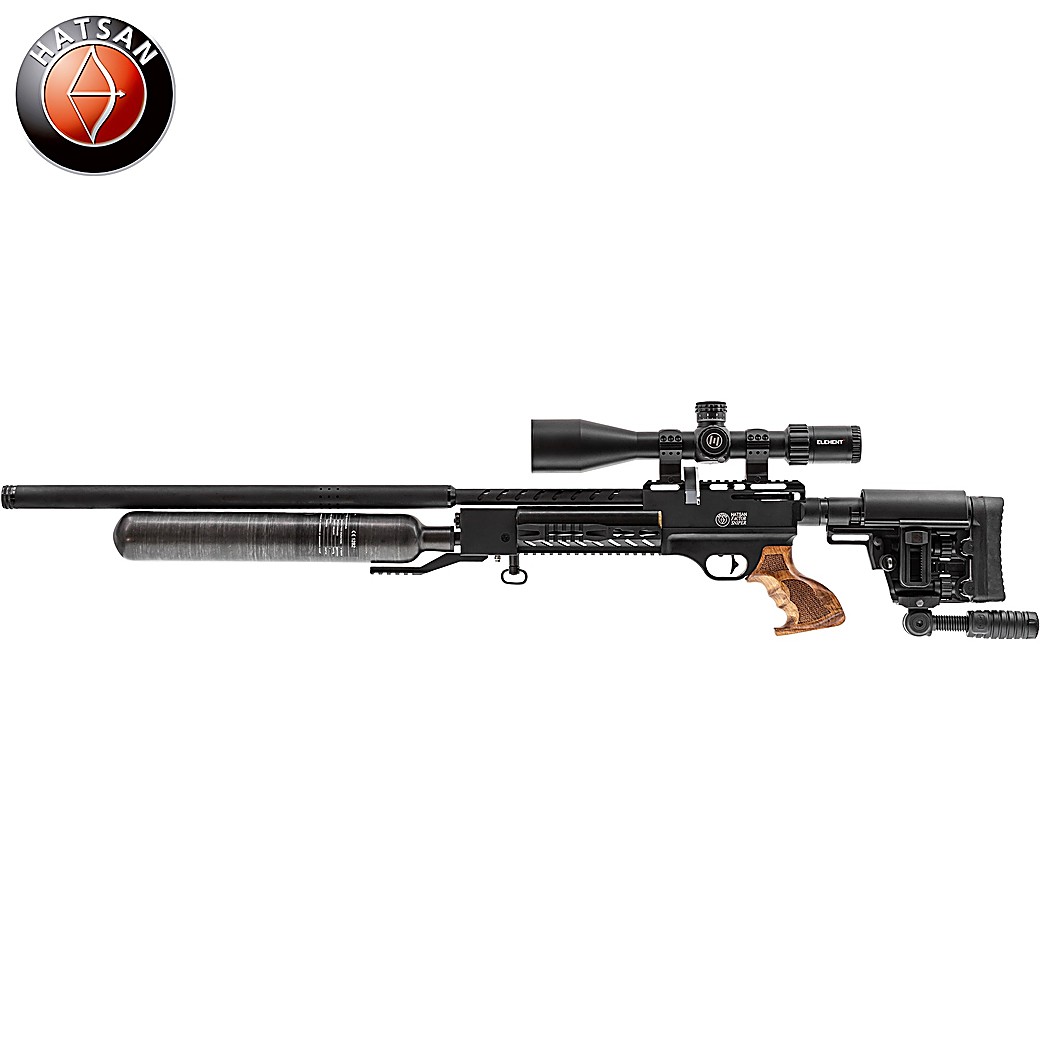
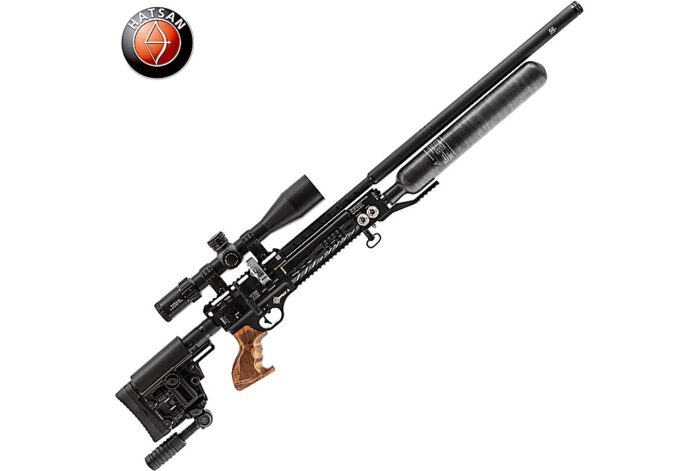
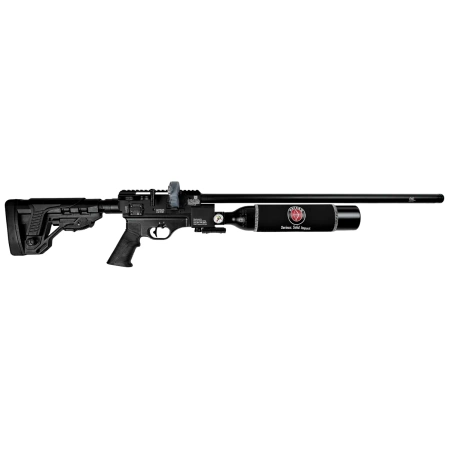
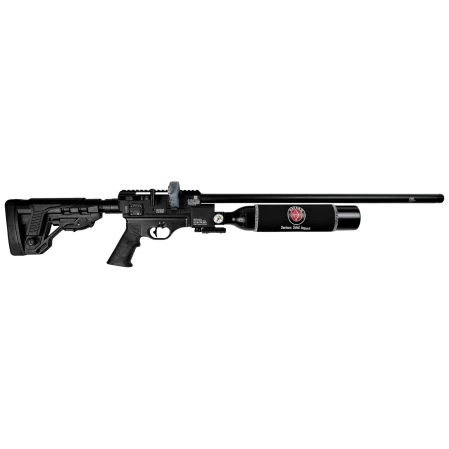
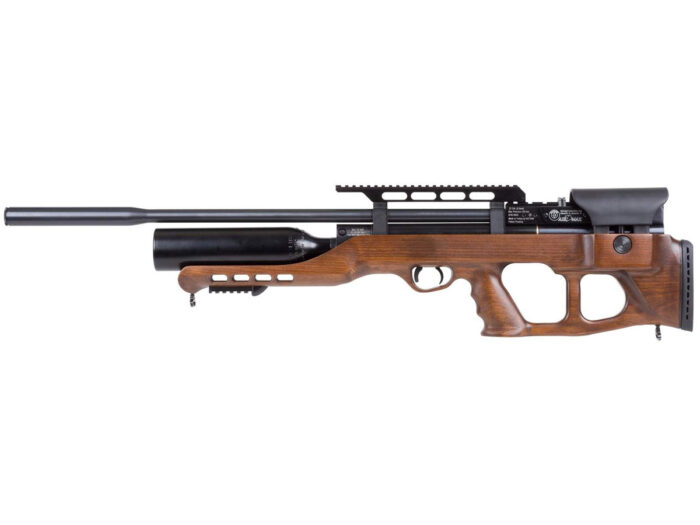
Hatsan introduces the Factor Sniper L Air Rifle, a stable platform for long range shooting.
Accuracy focused, comes with a long 760 mm fully shrouded barrel, a sturdy impact-resistant aluminium frame and with a telescopic tactical stock.
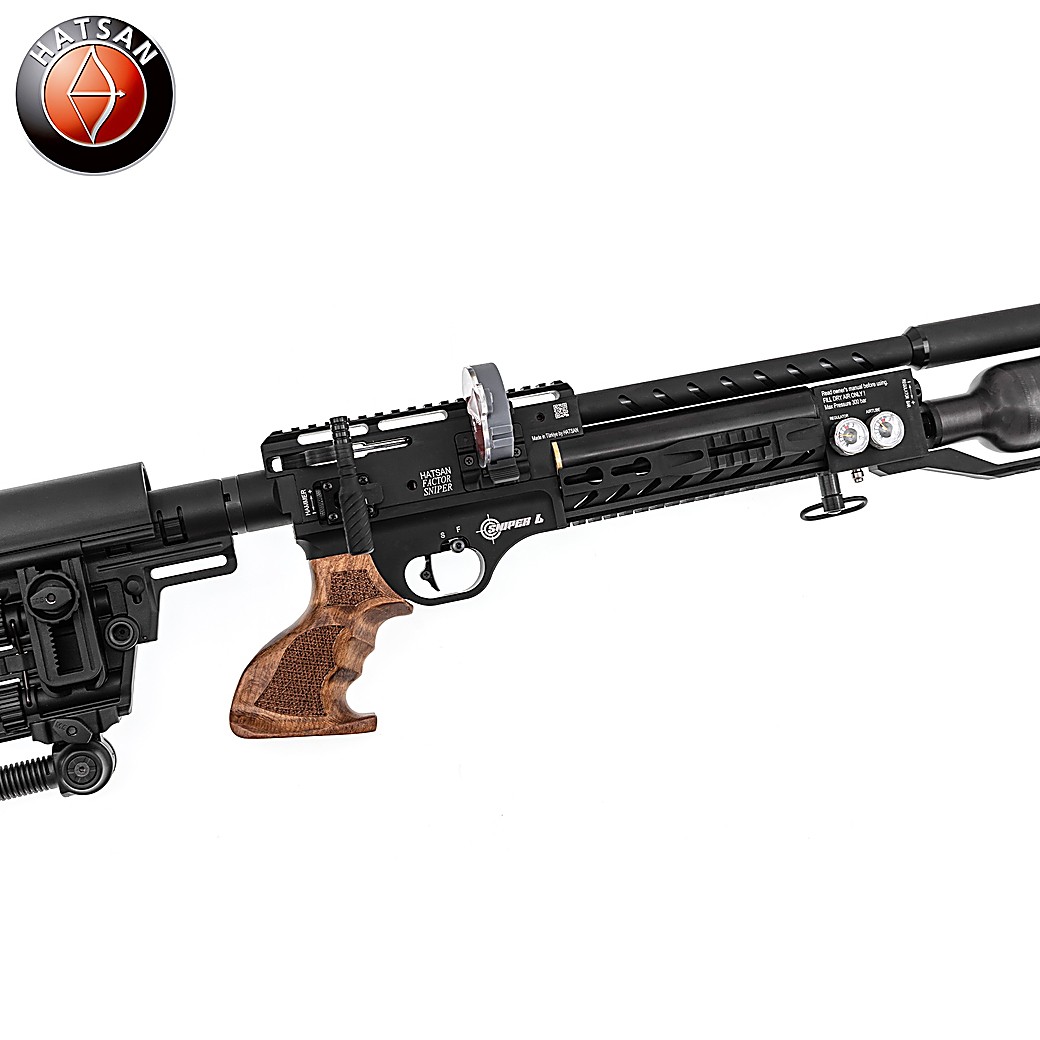
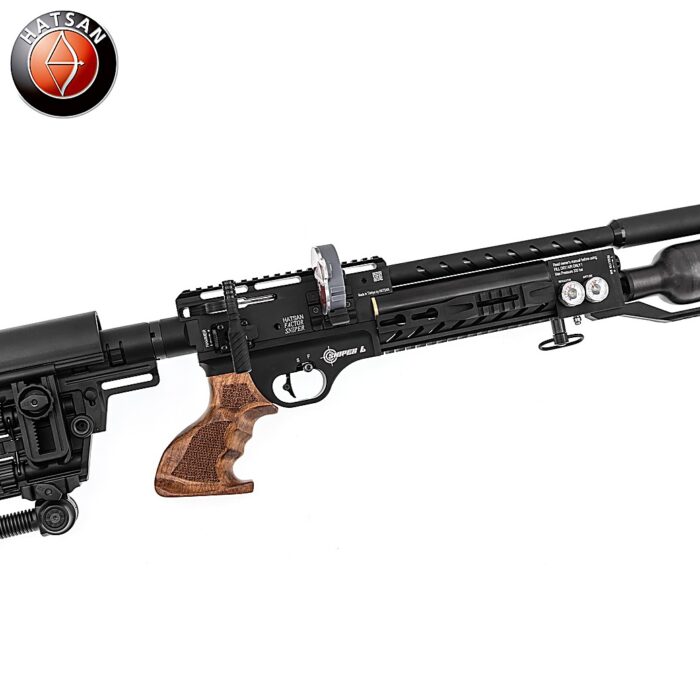
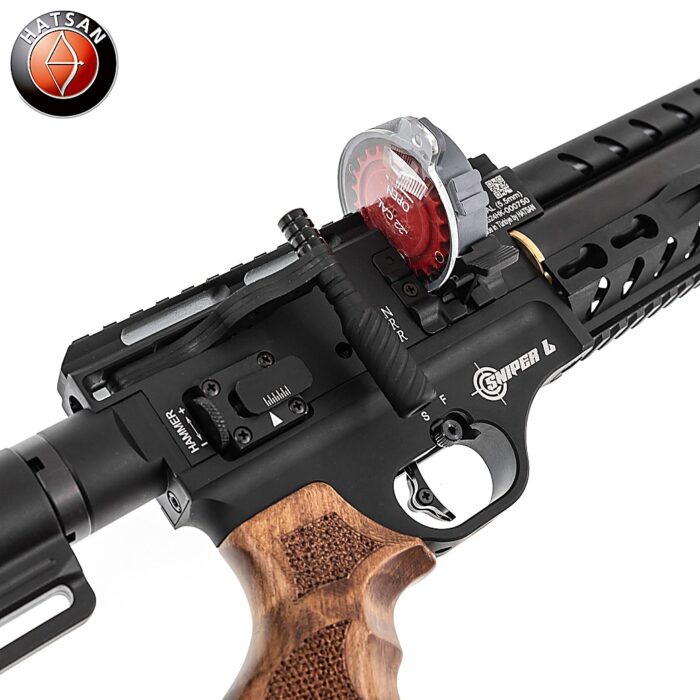
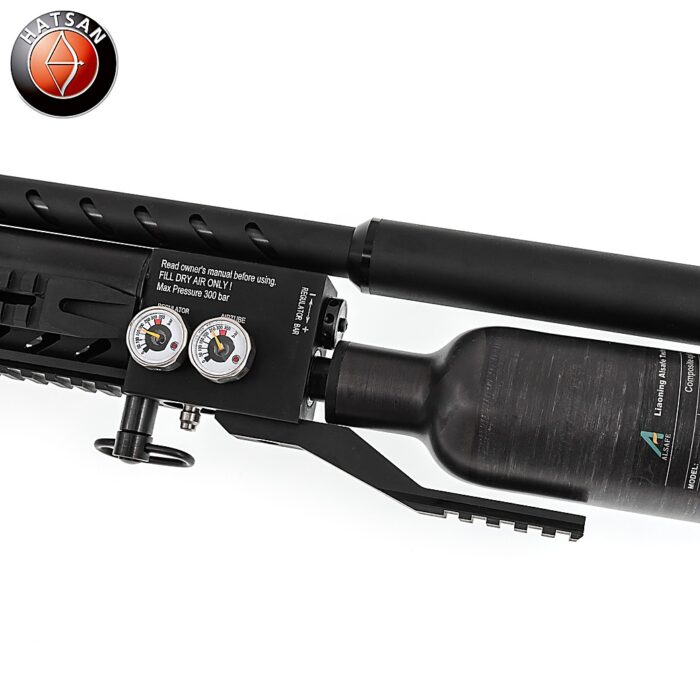
It features a 700 cc carbon fiber air bottle, 100 cc plenum, pressure and regulator gauges, externally adjustable regulator and hammer preload, “Quattro” match trigger, adjustable cheek piece and rubber but pad.
The Hatsan Factor Sniper L offers a blend of accuracy, strength, and convenience in a solid design, making it an ideal option for those looking for a top-tier, long-range, air rifle.
Hatsan Factor Sniper L PCP Air Rifle – Long-Format Regulated PCP Precision and High-Capacity Performance
The Hatsan Factor Sniper L PCP Air Rifle is a long-format regulated pre-charged pneumatic platform created for shooters who value stability, substantial air capacity, precision-oriented ergonomics and extended target sessions.
The “L” designation identifies the longer configuration within the Factor Sniper family. Compared with more compact PCP rifles, this model uses a 760mm / 30-inch precision-rifled and choked steel barrel, a large 700cc detachable carbon-fiber bottle, and an additional 100cc pre-air chamber.
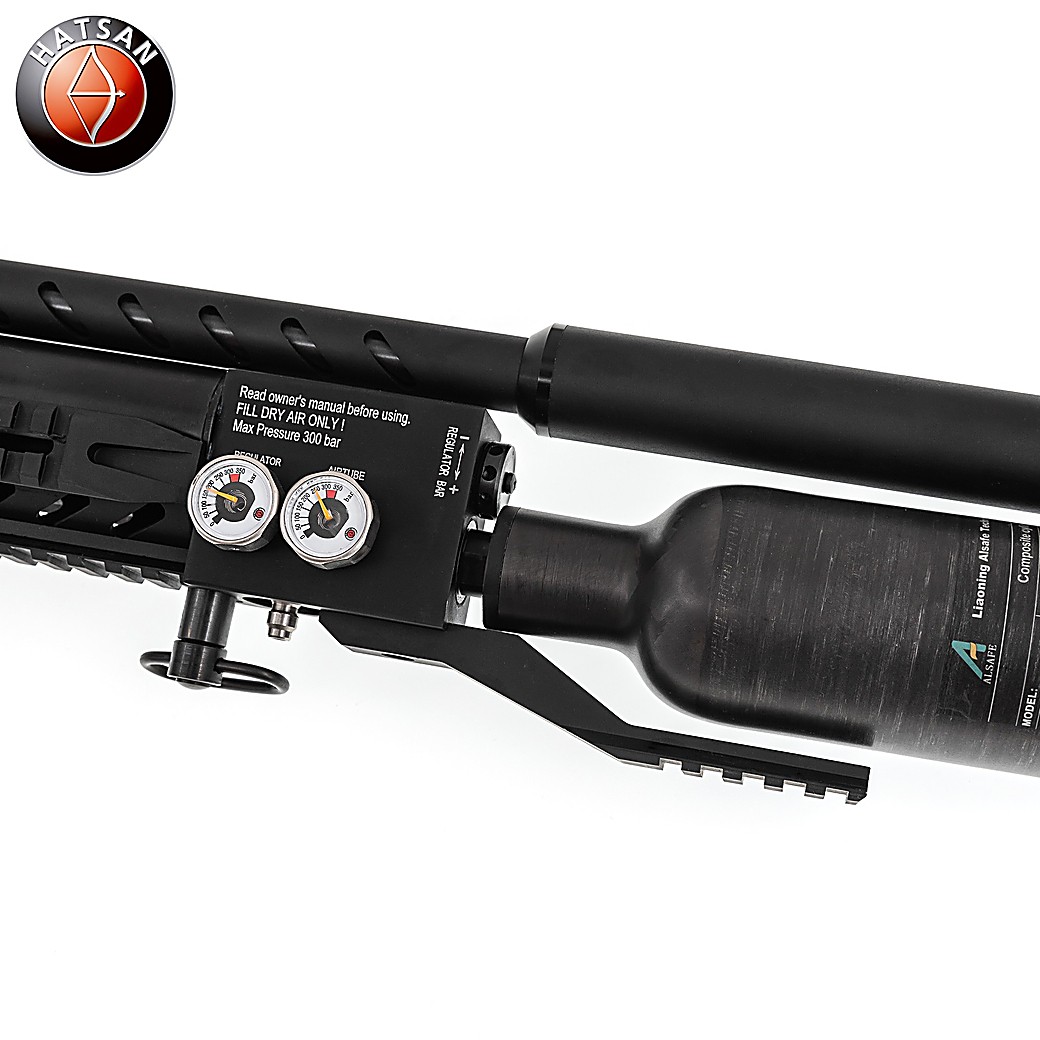
Maximum fill pressure is 300 bar, giving the rifle a substantial compressed-air reserve. Meanwhile, an externally adjustable regulator and separate regulator-pressure gauge form part of the factory architecture.
Current factory calibre options include:
- .22 / 5.5mm
- .25 / 6.35mm
- .30 / 7.62mm
- .35 / 9mm
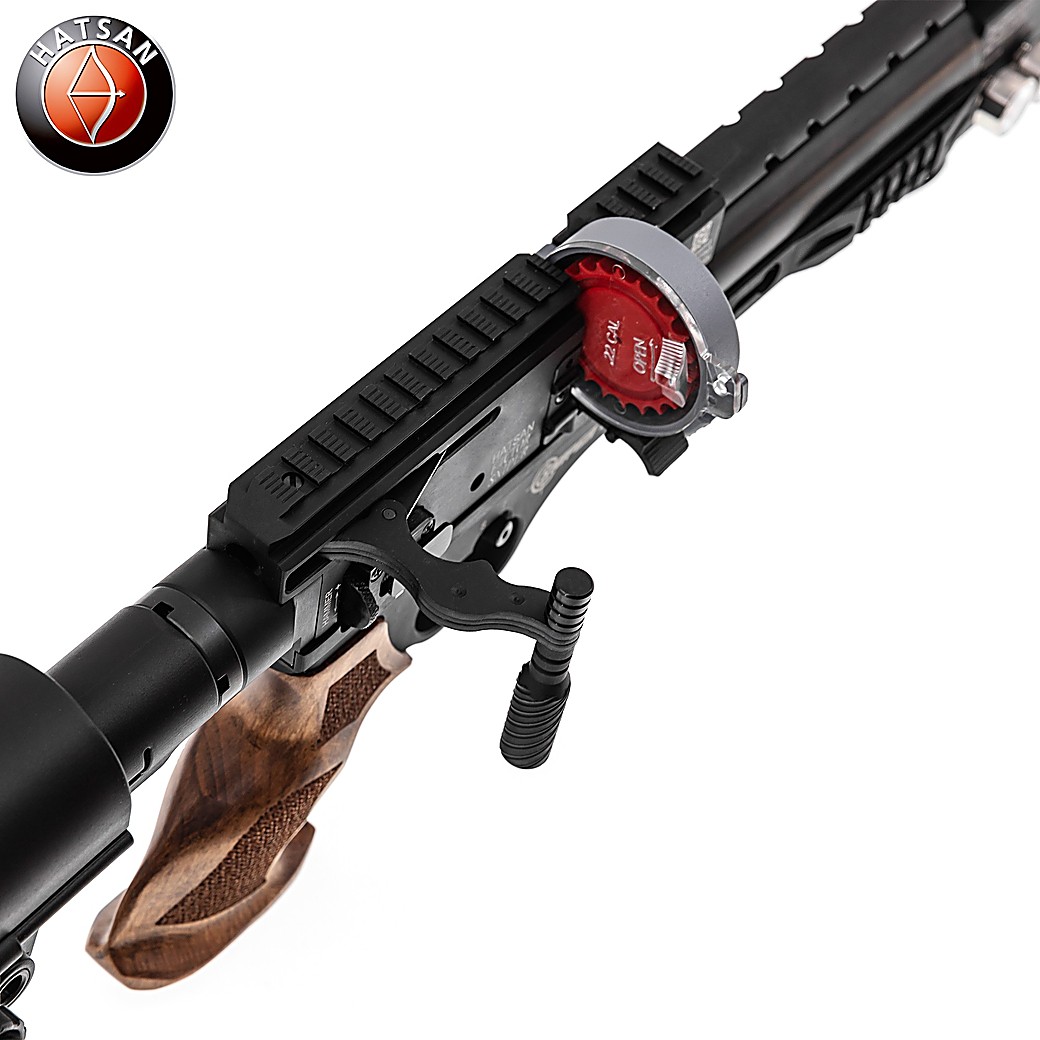
Magazine capacity depends on calibre, with Hatsan listing approximately 21 rounds in .22, 19 in .25, 16 in .30 and 13 in .35 for the standard magazines. Two magazines are supplied according to the current factory specification.
700cc Carbon-Fiber Air Bottle
The large carbon-fiber bottle is one of the most important features of the rifle.
At 700cc, it gives the platform significantly more air capacity than many conventional PCP rifles.
That added capacity helps reduce the frequency of refilling during controlled target sessions.
Carbon fiber also provides a useful strength-to-weight ratio compared with a similarly sized conventional metal cylinder.
300-Bar Fill Pressure
The rifle uses a maximum working fill pressure of 300 bar.
Because this is a high-pressure pneumatic system, only properly rated PCP filling equipment should be used.
The bottle should never be filled beyond the manufacturer’s stated pressure limit.
100cc Pre-Air Chamber
In addition to the main bottle, the rifle incorporates a 100cc pre-air chamber.
This forms part of the rifle’s regulated air-delivery architecture and contributes to consistent air availability for the firing valve.
Externally Adjustable Regulator
An external regulator is integrated into the platform.
The regulator is intended to support consistent pressure delivery through the useful portion of the air charge.
A separate pressure gauge allows regulator pressure to be monitored.
Any adjustment should remain within manufacturer guidance and applicable local power restrictions.
Precision-Rifled 760mm Barrel
The 760mm steel barrel is precision rifled and choked.
Its long profile provides a stable platform for projectile guidance before muzzle exit.
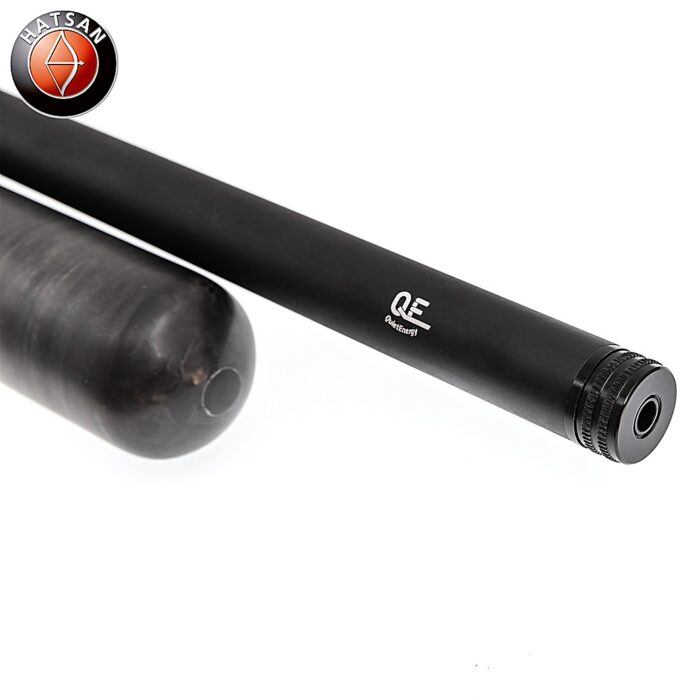
The barrel is also incorporated into Hatsan’s QuietEnergy shrouded architecture.
Actual accuracy depends on the entire shooting system, including suitable ammunition, optic alignment, air consistency, shooting position and environmental conditions.
QuietEnergy Barrel System
The barrel is fully shrouded and incorporates Hatsan’s sound-moderating design.
Hatsan describes this arrangement as substantially reducing report compared with an unshrouded configuration.
Local rules concerning sound moderators and related equipment should always be checked.
Reversible Sidelever
The cocking handle can be configured for ambidextrous operation.
That gives both left- and right-handed shooters more flexibility when establishing a comfortable shooting position.
The sidelever action also allows the rifle to remain relatively stable during repeated target strings.
Quattro Trigger
The rifle incorporates Hatsan’s two-stage adjustable Quattro Trigger.
Trigger travel and trigger load can be adjusted within the manufacturer’s intended design.
The trigger shoe itself also provides vertical and horizontal adjustment.
This helps the shooter establish a more natural finger position.
Modular Precision Stock
The rifle uses a Mil-Spec modular precision buttstock.
An elevation-adjustable cheek rest supports consistent head placement.
A rubber butt pad improves shoulder contact.
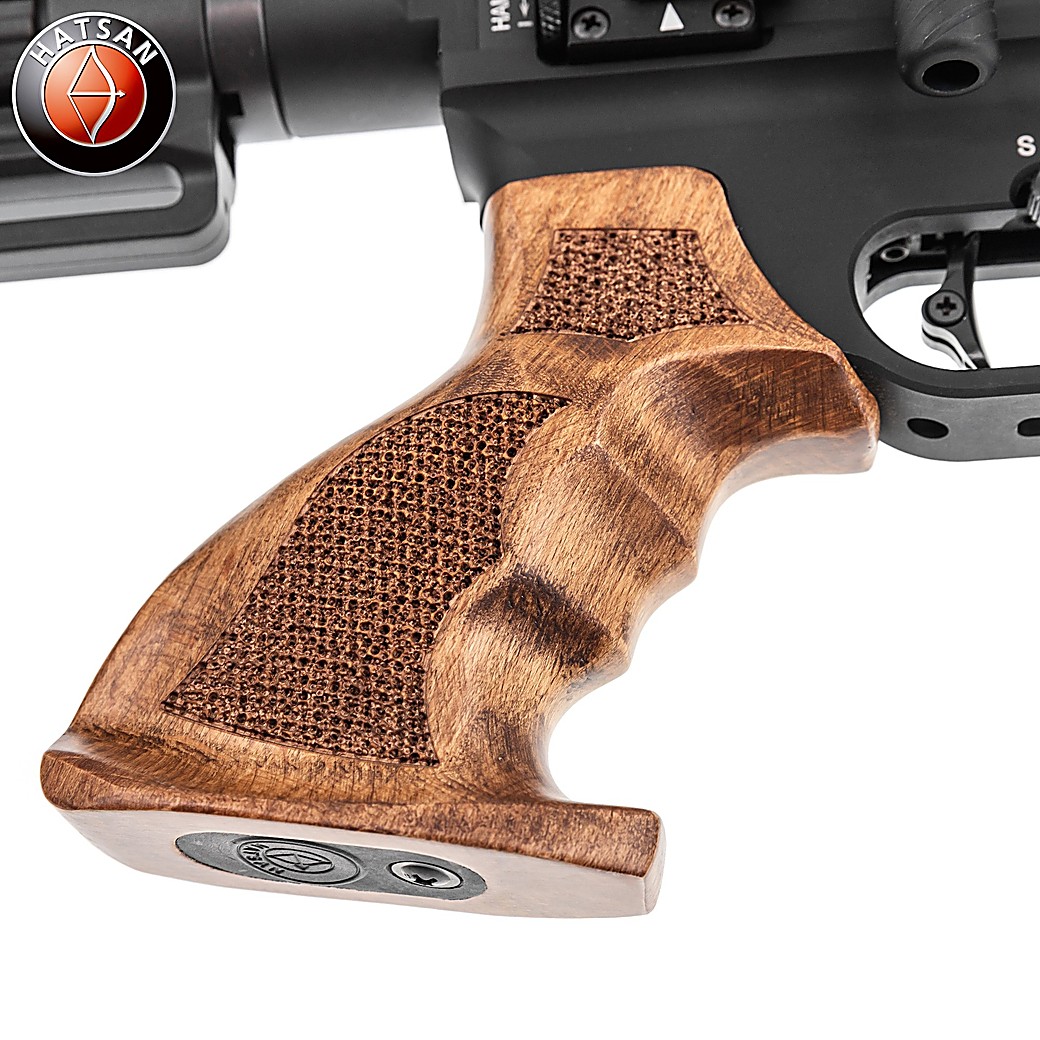
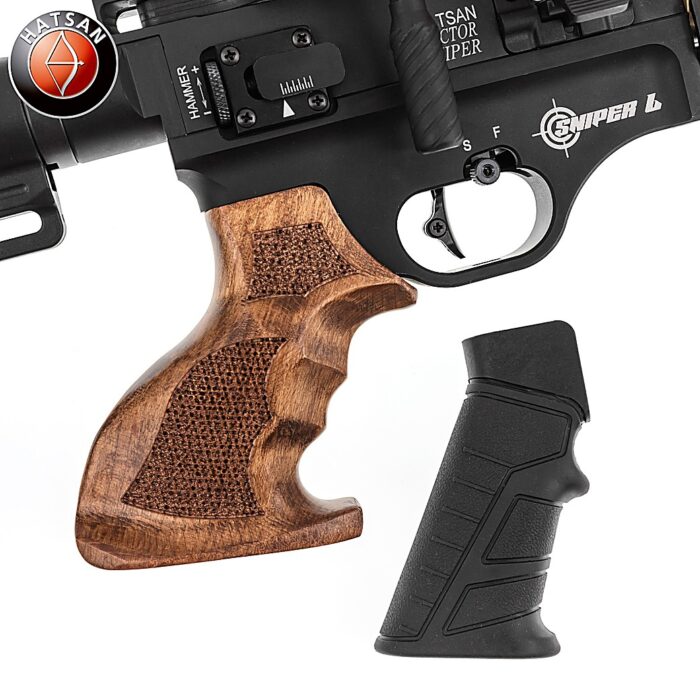
The platform also combines an ergonomic wood grip with a soft-rubber pistol grip configuration depending on current model specification.
Overall Size
The rifle is approximately 1180mm long with the stock shortened and approximately 1260mm with the stock extended.
Average weight is listed at around 5kg.
This makes the Sniper L a substantial full-size PCP rather than an ultralight field rifle.
Why the Long Configuration Matters
A longer rifle can provide a steadier feel during supported precision shooting.
The extended barrel, large bottle and substantial chassis give the platform a planted character from a bench or other controlled position.
However, the additional size and weight should also be considered when deciding whether the rifle suits the intended shooting environment.
CARABINA HATSAN PCP BT65 SB ELITE
The CARABINA HATSAN PCP BT65 SB ELITE represents another established Hatsan PCP platform.
The BT65 follows a more traditional tactical PCP approach, while the Factor Sniper L adds a much larger carbon-fiber reservoir, a longer barrel and more extensive regulation architecture.
hatsan air rifle
A hatsan air rifle can range from straightforward break-barrel models to sophisticated regulated PCP platforms.
The Sniper L sits near the precision-oriented end of the company’s pneumatic range.
hatsan sortie
The hatsan sortie is a compact semi-automatic PCP platform.
In contrast, the Sniper L uses a manually operated sidelever and emphasizes deliberate precision shooting.
hatsan velox
The hatsan velox represents another modern pneumatic Hatsan platform.
Its dimensions and operating philosophy differ significantly from the long-format Sniper L.
hatsan jet 2
The hatsan jet 2 is considerably more compact.
The Sniper L instead provides a 760mm barrel, very large air bottle and substantial precision chassis.
hatsan model 95
The hatsan model 95 is a break-barrel rifle.
It does not require compressed-air filling equipment and therefore offers a much simpler operating system.
hatsan flash
The hatsan flash is a lighter PCP platform aimed at shooters who value portability.
The Sniper L focuses more strongly on large air capacity and stable precision-oriented shooting.
hatsanusa
Searches for hatsanusa generally relate to Hatsan products, support and availability in the United States.
Exact specifications can vary between markets.
hatsan usa
hatsan usa buyers should verify local power, ownership and product requirements before choosing a specific configuration.
hatsan harpoon
The hatsan harpoon is a specialist compressed-air launcher and does not serve the same purpose as a conventional pellet or slug-firing target rifle.
hatsan mod 95
The hatsan mod 95 provides self-contained break-barrel operation, whereas the Sniper L relies on a rechargeable high-pressure pneumatic system.
hatsan sortie tact
The hatsan sortie tact is a shorter tactical semi-automatic option.
The Sniper L provides substantially greater length and air capacity.
hatsan hercules
The hatsan hercules family also emphasizes high-volume PCP performance.
The Sniper L differentiates itself with its precision chassis, regulated architecture and long barrel.
hatsan piledriver
The hatsan piledriver belongs to Hatsan’s large-bore PCP category.
Its design goals differ from the precision-focused multi-calibre Sniper L.
hatsan sortie tact semi-auto pcp
The hatsan sortie tact semi-auto pcp emphasizes quick semi-automatic operation.
The Sniper L instead uses deliberate sidelever cycling.
hatsan 135
The hatsan 135 is a powerful break-barrel platform and therefore does not require an external air source.
hatsan jet
The hatsan jet is built around compactness and portability.
The Sniper L represents almost the opposite design philosophy, prioritizing long-barrel stability and air capacity.
hatsan bullboss
The hatsan bullboss uses a bullpup layout to reduce overall length.
The Sniper L uses a conventional long rifle configuration.
hatsan 95
The hatsan 95 remains suited to shooters who prefer spring-powered simplicity.
The Sniper L is intended for users prepared to manage a regulated PCP system.
hatsan
hatsan manufactures air rifles across break-barrel, gas-piston and PCP categories.
The Factor Sniper L represents one of the company’s larger regulated precision-oriented PCP platforms.
hatsan refurbished
A hatsan refurbished rifle should be evaluated for service history, bottle condition, seal integrity, barrel condition, trigger function and warranty coverage.
hatsan hercules bully
The hatsan hercules bully uses a bullpup configuration with substantial air capacity.
The Sniper L instead uses a long traditional rifle profile.
hatsan airtact air rifle
The hatsan airtact air rifle offers straightforward break-barrel shooting.
The Sniper L provides a far more complex pneumatic system.
hatsan invader
The hatsan invader emphasizes semi-automatic PCP operation.
The Sniper L instead emphasizes controlled sidelever shooting and regulated precision.
hatsan flashpup qe
The hatsan flashpup qe uses compact bullpup dimensions and a shorter overall package.
The Sniper L is substantially longer.
hatsan neutron star
The hatsan neutron star belongs to another area of Hatsan product searches.
Specifications should always be checked against the exact model rather than transferred between rifles.
hatsan mod 25
The hatsan mod 25 is a compact air pistol rather than a full-length PCP rifle.
hassan blitz
Searches for hassan blitz usually refer to the Hatsan Blitz.
That platform emphasizes rapid selectable operation in permitted markets, whereas the Sniper L uses a manual sidelever.
air pellet gun
As an air pellet gun, the Sniper L uses stored compressed air rather than firearm cartridges.
It should still be handled with strict muzzle discipline and used only with a secure backstop.
co2 pellet rifle
A co2 pellet rifle is powered by carbon dioxide.
The Sniper L instead uses high-pressure compressed air stored inside a carbon-fiber bottle.
hercules bully air rifle
The hercules bully air rifle represents another large-capacity Hatsan PCP but uses a compact bullpup layout.
hatsan sortie threaded adapter
A hatsan sortie threaded adapter is model-specific.
It should not be assumed compatible with the Factor Sniper L.
h&n field target trophy
The h&n field target trophy is a well-known domed pellet line.
Actual compatibility depends on the rifle’s calibre, chamber and individual barrel preference.
hatsan bt65.25 specifications
Searches for hatsan bt65.25 specifications refer to the .25-calibre BT65 platform.
Those specifications should not be transferred to the Sniper L.
hatsan jet i pcp .22 caliber pellet rifle kit
The hatsan jet i pcp .22 caliber pellet rifle kit represents a compact .22 PCP configuration.
It offers a much smaller air reservoir and barrel compared with the Sniper L.
model 95
The model 95 is intended for shooters who want a simple self-contained spring-powered platform.
The Sniper L is a high-capacity PCP requiring dedicated filling equipment.
Snowpeak PP750L PCP Air Pistol
The Snowpeak PP750L PCP Air Pistol belongs to another manufacturer and focuses on compact pneumatic portability.
It differs substantially from the Sniper L’s full-size precision format.
snowpeak airguns
snowpeak airguns include PCP pistols, conventional rifles and bullpups.
They should be compared using exact model-specific specifications.
snowpeak sports
Searches for snowpeak sports often relate to Snowpeak airguns and associated equipment.
snowpeak ap900
The snowpeak ap900 represents another airgun platform and should be evaluated independently.
snowpeak max
The phrase snowpeak max may refer to different Snowpeak products depending on the market.
Always verify the exact model.
snowpeak pp750
The snowpeak pp750 is a compact PCP pistol/carbine platform.
Its design priorities are very different from the Sniper L.
pp750
The pp750 provides portable PCP dimensions, whereas the Sniper L prioritizes stability and high air capacity.
snowpeak p35x
The snowpeak p35x uses a compact bullpup configuration.
The Sniper L uses a much longer conventional rifle layout.
pr900 gen 3
The pr900 gen 3 offers a lighter and simpler PCP experience.
The Sniper L includes substantially more adjustment and air capacity.
snow peak pp750
The snow peak pp750 remains a compact alternative to large precision PCP rifles.
snowpeak p35
The snowpeak p35 uses a bullpup layout that keeps overall length considerably shorter.
snowpeak m60b
The snowpeak m60b represents another modern PCP platform and should be compared through verified specifications.
snow peak pp20
The snow peak pp20 is an air-pistol platform rather than a long rifle.
p35
The p35 is generally associated with Snowpeak’s compact bullpup PCP family.
p35x
The p35x continues that compact bullpup design approach.
p35x pcp
A p35x pcp is substantially shorter than the long-format Sniper L and provides different handling characteristics.
snowpeak m25
The snowpeak m25 represents another PCP rifle alternative that should be compared on exact specifications and lawful intended use.
ap900b pcp air rifle
The ap900b pcp air rifle belongs to Snowpeak’s pneumatic range and follows a different design philosophy.
snowpeak m60
The snowpeak m60 provides another PCP option for shooters comparing ergonomics, operating systems and air capacity.
Why the Sniper L Stands Out
The Factor Sniper L distinguishes itself primarily through size, regulation and air capacity.
The 700cc carbon-fiber bottle provides a substantial air reserve.
The 300-bar maximum fill pressure supports long shooting strings.
The 100cc pre-air chamber adds another stage to the regulated air system.
The 760mm barrel creates a long precision-oriented platform.
Meanwhile, the modular stock, adjustable cheekpiece and configurable trigger interface help the shooter establish a repeatable position.
Factory Shot Count
Hatsan currently lists approximately:
- 100 optimal-velocity shots in .22
- 80 in .25
- 70 in .30
- 70 in .35
The exact result depends on ammunition, pressure, environmental conditions and configuration.
Factory Performance Figures
In unrestricted factory specifications, Hatsan lists maximum output figures up to approximately:
- 133 joules / 98 ft-lb in .22
- 156 joules / 115 ft-lb in .25
- 213 joules / 157 ft-lb in .30
- 229 joules / 169 ft-lb in .35
These are manufacturer figures for unrestricted configurations and may not represent versions permitted or sold in every country.
Why Consistency Matters More Than Maximum Output
For controlled precision shooting, maximum energy is only one specification.
Repeatable velocity is usually more important.
Stable air pressure, suitable ammunition, a secure optic, consistent trigger technique and a repeatable shooting position collectively influence group quality.
The strongest setup is therefore not automatically the one producing the highest possible velocity.
How the Platform Supports Precision
Several design elements contribute to repeatability.
The regulator controls air delivery.
The large bottle reduces the frequency of refilling.
The long barrel provides a stable rifled pathway.
The adjustable cheekpiece supports repeatable eye alignment.
The Quattro trigger gives the shooter a predictable trigger interface.
The telescopic precision stock can be adapted to body proportions.
Together, these features provide a strong mechanical foundation for range accuracy.
Why Ammunition Selection Matters
Different barrels can prefer different pellets or manufacturer-approved projectile types.
Diameter matters.
Weight matters.
Manufacturing consistency matters.
Projectile condition matters.
Rather than assuming that the fastest option is automatically best, shooters should compare groups safely at a controlled range.
Where the Rifle Makes the Most Sense
The Sniper L is especially well suited to controlled shooting environments where its size and weight are an advantage rather than a burden.
A stable range bench allows the rifle’s substantial chassis and long barrel to work effectively.
Where private target shooting is legally permitted, an adequate backstop and controlled firing area remain essential.
When This Rifle Makes Sense
The platform makes particular sense for someone who wants:
A long-format regulated PCP.
A very large air reservoir.
A carbon-fiber bottle.
A 300-bar fill system.
A long precision barrel.
Multiple larger calibre choices.
High-capacity magazines.
A reversible sidelever.
An adjustable stock.
A precision-oriented trigger.
Long shooting strings.
Why the Stock Matters
A precision rifle should fit the shooter rather than force the shooter into an awkward position.
The adjustable cheekpiece helps align the eye with the optic.
The modular stock provides length adjustment.
A consistent shoulder position can improve repeatability from shot to shot.
Why the Rifle’s Weight Can Be Useful
At approximately 5kg, this is not an especially light PCP.
However, additional mass can provide stability during supported shooting.
A heavier rifle tends to move less easily on a bench when properly supported.
The trade-off is greater effort during prolonged unsupported shooting.
Important High-Pressure Air Information
The rifle contains air at extremely high pressure.
The air bottle, regulator, pressure gauges and internal pneumatic components should not be casually dismantled while pressurized.
Hatsan’s manual specifically warns against disassembling pressurized PCP components except by competent service personnel.
Use only filling equipment designed for the required pressure.
Keep connections clean.
Protect the bottle from impact.
Never exceed the stated working pressure.
Why Legal Configuration Matters
Power limits, licensing requirements and airgun classifications vary greatly between jurisdictions.
A configuration permitted in one country may require licensing or may not be lawful in another.
The factory figures above therefore describe product capability rather than universal legal limits.
Final Section 1 Assessment
The Hatsan Factor Sniper L PCP Air Rifle is a substantial regulated PCP developed around long shooting strings, extensive air capacity and precision-oriented handling.
Its defining components include a 700cc detachable carbon-fiber air bottle, 300-bar maximum fill pressure, 100cc pre-air chamber, 760mm precision-rifled and choked steel barrel, externally adjustable regulator, regulator-pressure gauge, reversible sidelever and adjustable Quattro trigger.
Current factory offerings extend from .22 through .35 calibre, with magazine capacities ranging from 21 rounds in .22 to 13 rounds in .35.
The rifle’s large dimensions and approximately 5kg weight make it particularly suited to controlled supported shooting rather than users seeking the lightest possible PCP.
Its strongest characteristics are stability, large air capacity, regulation, long-barrel architecture, ergonomic adjustment and broad calibre availability.
However, maximum power should never be treated as the only measure of quality.
For precision use, a suitable projectile, stable air pressure, secure optic, correct stock fit and disciplined shooting technique matter far more than simply pursuing the highest possible velocity.
Used within manufacturer limits, maintained responsibly and configured according to local law, the Factor Sniper L provides a technically sophisticated platform for lawful precision target shooting and extended range practice.
Practical Accuracy, Air Management, Handling, Optics, Maintenance and Long-Term Ownership
Understanding the Rifle as a Long-Format Precision PCP
The Factor Sniper L is best understood as a large, regulated PCP platform built around stability, substantial air capacity, adjustable ergonomics, and long shooting sessions.
Its performance depends on more than one feature.
The air system matters.
The regulator matters.
The barrel matters.
The trigger matters.
The stock matters.
The magazine matters.
The optic matters.
The ammunition matters.
The shooter matters.
When these elements are matched correctly, the rifle can provide a very stable and repeatable shooting experience in lawful target environments.
Why the Long Configuration Matters
The rifle uses a long barrel and a substantial chassis.
That changes the way it handles compared with a compact PCP.
A longer system can feel more planted from a bench or other supported position.
The trade-off is additional weight and overall length.
This makes the rifle especially suitable for shooters who prioritize stability over portability.
Why Weight Can Help Precision
A heavier rifle can resist small movements more effectively when supported correctly.
The additional mass can make it easier to hold the sight picture steady.
This can be useful during deliberate target shooting.
However, the same weight becomes more noticeable during unsupported standing positions.
Why Balance Matters
Overall weight is only one part of handling.
Balance is equally important.
The large air bottle, long barrel, optic, and stock all influence how the rifle feels.
A well-balanced setup can feel easier to control than a lighter rifle with poor weight distribution.
Regulated Air Delivery
The regulator is one of the most important mechanical systems in the rifle.
Its purpose is to deliver air at a more consistent pressure to the firing system.
This can reduce shot-to-shot variation across the useful air charge.
Why Consistent Air Pressure Matters
A pellet or approved projectile reacts to the amount of energy delivered behind it.
If pressure varies significantly between shots, velocity can also vary.
That can change the point of impact.
A regulated system helps reduce that variable.
Regulator Consistency and Group Size
Consistent regulation does not automatically create tight groups.
However, it gives the rifle a more stable mechanical foundation.
The shooter can then focus on other important variables such as:
Ammunition quality.
Optic alignment.
Trigger technique.
Wind.
Position.
Follow-through.
Main Air Bottle
The large carbon-fiber bottle is one of the rifle’s defining features.
Its capacity supports long shooting strings between fills.
This is particularly useful during range sessions where frequent interruptions would reduce concentration.
Why Carbon Fiber Is Useful
Carbon-fiber bottles can provide substantial strength while controlling overall weight.
That is especially important on a rifle already carrying a long barrel and precision-oriented chassis.
The bottle should still be treated carefully.
Protecting the Bottle
The bottle should be protected from:
Hard impacts.
Cuts.
Deep abrasion.
Excessive heat.
Unauthorized modification.
Chemical exposure.
Any significant damage should be inspected professionally.
Monitoring Pressure
The shooter should monitor the pressure gauges regularly.
Shot count estimates are useful, but actual pressure provides a clearer indication of remaining air.
The rifle should not be operated outside the manufacturer’s intended pressure range.
High-Pressure Filling
The system operates at very high pressure.
Only proper PCP filling equipment should be used.
Suitable sources can include:
A rated compressor.
A compatible carbon-fiber tank.
A rated dive cylinder.
A properly designed high-pressure pump.
All connectors should match the system and remain clean.
Why Slow Filling Is Preferable
Fast filling generates heat.
A slower, controlled fill gives the shooter more time to monitor pressure and reduces unnecessary thermal stress.
The bottle should never be intentionally overfilled.
Why Clean Air Matters
Moisture and contamination can affect seals and internal components over time.
Clean, dry air is preferable.
Filling equipment should be maintained correctly.
Temperature and Pressure
Air pressure changes with temperature.
A bottle filled while warm may show a lower reading after cooling.
This is normal.
The rifle should never be heated artificially in an attempt to raise pressure.
Pre-Air Chamber
The additional air chamber forms part of the rifle’s regulated operating system.
It supports the controlled release of air during firing.
The shooter does not need to manipulate this system during ordinary use.
Sidelever Operation
The sidelever allows the shooter to chamber the next round while keeping the rifle relatively stable.
A smooth action is important.
The lever should not feel rough or excessively stiff.
Why Smooth Cycling Matters
A smooth loading cycle reduces unnecessary movement between shots.
This helps the shooter maintain:
Cheek position.
Shoulder contact.
Support-hand position.
Optic alignment.
This can make longer target strings more efficient.
Avoiding Force
If the sidelever becomes unusually difficult to operate, it should not be forced.
The cause may be:
Magazine position.
A damaged projectile.
Debris.
Internal wear.
A mechanical fault.
The rifle should be inspected safely.
Magazine Use
The magazine system provides multiple shots before reloading.
This can make long target sessions more convenient.
However, the magazine should still be handled carefully.
Magazine Inspection
Check for:
Cracks.
Debris.
Pellet damage.
Indexing problems.
Uneven rotation.
Wear.
A damaged magazine can create feeding issues that may be mistaken for rifle problems.
Loading Carefully
Pellets or approved projectiles should be loaded without damaging their skirts or heads.
Damaged ammunition can affect both feeding and accuracy.
Why Ammunition Quality Matters
The rifle’s mechanical precision cannot compensate fully for inconsistent ammunition.
Differences in:
Weight.
Diameter.
Shape.
Surface finish.
Manufacturing quality.
can influence group size.
Testing Ammunition Properly
A controlled test should use the same:
Distance.
Rest.
Air-pressure range.
Optic.
Target.
Shooting position.
Then group size can be compared meaningfully.
Why Maximum Velocity Is Not the Goal
The fastest possible projectile is not automatically the most accurate.
A slightly slower option may produce better consistency and tighter groups.
Precision should be prioritized over raw speed.
Barrel Performance
The long rifled barrel provides a stable pathway for the projectile.
Its length supports a precision-oriented shooting platform.
The barrel should remain clean and protected.
Crown Protection
The muzzle crown should be protected from impact.
Damage in this area can affect the way the projectile exits the barrel.
The muzzle should never be rested directly against hard surfaces.
Barrel Cleaning
Aggressive cleaning should be avoided unless necessary.
Cleaning should be conservative and follow manufacturer guidance.
Improper rods or abrasive materials can damage the bore.
When Cleaning May Help
Cleaning may be appropriate when:
Accuracy deteriorates unexpectedly.
Contamination is suspected.
The rifle has been stored for a long period.
A new ammunition type behaves unusually.
A technician recommends it.
Trigger Control
The trigger is one of the most important interfaces between shooter and rifle.
A smooth trigger press helps prevent the rifle from moving at the moment of release.
Trigger Familiarity
The shooter should become familiar with:
Take-up.
Break.
Reset.
Travel.
Finger placement.
A predictable trigger helps improve consistency.
Trigger Shoe Position
The adjustable trigger shoe allows the shooter to improve finger placement.
A natural position can reduce unwanted lateral pressure.
Safe Trigger Handling
The trigger should only be touched when the rifle is pointed safely and the shooter intends to fire.
Mechanical safety features are secondary to safe handling.
Stock Adjustment
The adjustable stock allows the rifle to be fitted more closely to the shooter.
Length of pull can influence:
Trigger reach.
Shoulder position.
Head position.
Balance.
Comfort.
Cheekpiece Adjustment
The cheekpiece should support a natural head position behind the optic.
The shooter should not need to stretch or compress the neck awkwardly.
A consistent cheek position improves repeatable eye alignment.
Shoulder Contact
The butt should contact the shoulder in the same place for every shot.
This helps keep the rifle and optic aligned consistently.
Support-Hand Position
The support hand should remain stable but relaxed.
Excessive gripping pressure can introduce unnecessary movement.
Benchrest Use
The rifle is particularly well suited to supported bench shooting.
Its length and weight can become advantages when the rifle is properly rested.
A stable bench helps reduce body movement during testing.
Front Rest Position
The front support should be positioned so that it does not interfere with magazines, controls, or the bottle.
The rifle should still be controlled by the shooter.
Rear Support
A rear bag can help stabilize the stock during careful target shooting.
Adjustments should be made gradually rather than forcing the rifle into position.
Standing Shooting
Standing use is more demanding because of the rifle’s weight.
Short practice sessions may be preferable until the shooter becomes comfortable with the balance.
Kneeling and Seated Positions
Kneeling and seated positions can offer a useful compromise between mobility and stability.
The adjustable stock helps adapt the rifle to different body positions.
Optic Selection
A suitable optic should match the intended shooting distances.
Useful features may include:
Clear glass.
Reliable tracking.
Appropriate magnification.
Correct eye relief.
A practical reticle.
Good mount compatibility.
Why More Magnification Is Not Always Better
High magnification can make small movements appear larger.
It can also reduce field of view.
The best magnification is the one that supports the intended target distance and shooting style.
Scope Mounts
Mount quality is critical.
Loose mounts can create shifting groups.
Mount screws should be checked periodically.
Scope Height
The cheekpiece should be adjusted to match optic height.
The shooter should be able to shoulder the rifle and see through the optic naturally.
Zeroing
Zeroing should be completed at a safe range.
Use:
A secure backstop.
A known distance.
Consistent ammunition.
A stable position.
Small optic adjustments.
Once zero is established, record it.
Confirming Zero
Zero should be checked after:
Transport.
Impact.
Mount changes.
Optic removal.
Maintenance.
Ammunition changes.
This can prevent unnecessary troubleshooting.
Chronograph Monitoring
A chronograph can help monitor consistency.
It can reveal:
Velocity spread.
Pressure-related changes.
Ammunition variation.
Possible regulator issues.
Possible seal problems.
Chronograph data should be used for monitoring and lawful configuration, not for bypassing legal limits.
Why Consistency Matters More Than Peak Numbers
A rifle that produces repeatable velocity can be easier to shoot accurately than one configured only for maximum output.
Precision depends on predictability.
Safe Range Use
A controlled range is one of the best environments for this rifle.
Known distances and secure backstops make testing easier.
The rifle’s size and weight are also easier to manage from a stable bench.
Private Shooting Areas
Where legally permitted, private target areas should have a secure backstop and sufficient distance from:
Roads.
Buildings.
People.
Animals.
Property boundaries.
The shooter should always know what lies behind the target.
Backstop Quality
A proper backstop should stop projectiles safely.
It should be wider and taller than the target area.
A weak or improvised backstop can create ricochet hazards.
Eye Protection
Appropriate eye protection is recommended.
Fragments, target debris, or ricochets can occur even during routine air-rifle shooting.
Sound Considerations
The shrouded barrel can reduce report, but the rifle should not be treated as silent.
Sound can vary with configuration and environment.
Local regulations should be followed.
Exterior Cleaning
After use, the rifle can be wiped down with a soft cloth.
Moisture should not remain on exposed metal surfaces.
Dust should be removed from moving parts.
Protecting the Finish
Avoid aggressive cleaners.
Some solvents can damage finishes, seals, synthetic components, or adhesives.
Only suitable maintenance products should be used.
Fill Port Care
The fill port should remain clean.
Dust or grit can damage seals.
Protective caps should be used where provided.
Seal Condition
Possible signs of seal problems include:
Unexpected pressure loss.
Audible leakage.
Reduced shot count.
Inconsistent performance.
Difficulty holding pressure.
Persistent leaks should be serviced.
Pressure Loss in Storage
A small change in pressure can occur because of temperature.
Continuous or substantial loss may indicate a leak.
The rifle should be inspected if pressure decreases repeatedly without use.
Avoiding Unauthorized Internal Work
High-pressure PCP components should not be casually disassembled.
Internal work should be completed according to manufacturer procedures by someone qualified to work on high-pressure pneumatic systems.
Regulator Adjustments
The rifle includes factory adjustment capability.
These controls should remain within manufacturer limits.
They should not be used to circumvent local power restrictions.
Power Adjustment and Accuracy
More power does not always improve accuracy.
Higher settings can sometimes increase:
Air consumption.
Noise.
Ammunition sensitivity.
Mechanical stress.
The best configuration is the one that provides consistent lawful performance.
Long-Term Storage
The rifle should be stored:
Dry.
Secure.
Away from excessive heat.
Away from children.
Away from chemicals.
Away from direct sunlight.
The manufacturer’s guidance should be followed regarding reservoir pressure during extended storage.
Bottle Inspection
The carbon-fiber bottle should be inspected regularly for visible damage.
Any deep scratches, impact marks, unusual deformation, or suspected structural damage should be evaluated professionally.
Transport
During transport, the rifle should be unloaded and secured.
The magazine should be removed where appropriate.
The rifle should be protected from impact.
Local transport laws should be followed.
Magazine Storage
Magazines should be stored clean and dry.
Damaged ammunition should not be left inside.
A protective case can help prevent debris contamination.
Documentation
Keep the following records:
Owner manual.
Serial number.
Purchase receipt.
Service history.
Bottle information.
Warranty details.
Chronograph notes.
Ammunition testing results.
Good records make future servicing easier.
Buying Used
A used rifle should be checked carefully before purchase.
Inspect:
Bottle condition.
Gauge function.
Regulator behavior.
Seals.
Barrel.
Stock.
Magazine system.
Trigger.
Safety.
Sidelever.
Optic rail.
Fill port.
Any modifications.
Questions for a Used Seller
Useful questions include:
Does the rifle hold pressure?
Has it been serviced?
Has the regulator been worked on?
Has the bottle suffered any impact?
Are all magazines included?
Has the rifle been modified?
What ammunition groups best?
Are there known leaks?
Clear answers can reduce uncertainty.
Ownership Costs
Long-term ownership may involve:
Ammunition.
Optics.
Mounts.
Filling equipment.
Replacement seals.
Magazines.
Professional servicing.
Range fees.
Storage equipment.
Bottle-related inspection or replacement requirements.
These costs should be considered before purchase.
Why a Large PCP Requires Planning
A high-capacity rifle offers long shooting sessions, but it also requires suitable filling support.
A small hand pump may be less convenient for a very large 300-bar bottle.
A dedicated high-pressure source may therefore be more practical.
Why Filling Equipment Matters
The rifle’s usefulness depends partly on how easily the owner can refill it.
A shooter with reliable access to a rated air source will generally find the platform easier to manage.
Ammunition Availability
Before choosing a calibre, buyers should consider whether suitable ammunition is readily available.
A larger calibre may offer different performance characteristics, but ongoing supply matters.
Calibre and Recoil Feel
PCP rifles generally produce less mechanical movement than spring rifles, but larger projectiles and higher-energy configurations can still create a more noticeable firing impulse.
The shooter should maintain consistent shoulder contact.
Why a Stable Position Matters
Precision shooting depends heavily on repeatability.
The same:
Cheek position.
Shoulder pressure.
Trigger placement.
Support-hand position.
should be used as consistently as possible.
Troubleshooting Large Groups
If accuracy suddenly deteriorates, check simple causes first:
Ammunition.
Air pressure.
Scope mounts.
Optic zero.
Magazine condition.
Wind.
Support position.
Barrel condition.
Do not change several variables at once.
Troubleshooting Feeding Problems
If feeding becomes unreliable:
Stop safely.
Remove the magazine.
Inspect the ammunition.
Check magazine condition.
Look for debris.
Avoid forcing the action.
Professional service may be appropriate if the problem persists.
Troubleshooting Air Loss
If pressure drops unexpectedly:
Observe the gauges.
Listen for leakage.
Check the fill connection.
Inspect accessible seals.
Avoid internal disassembly if the cause is unclear.
Routine Inspection
Regularly inspect:
Bottle.
Fill port.
Pressure gauges.
Sidelever.
Magazine.
Trigger.
Safety.
Stock adjustment.
Optic mounts.
Visible seals.
Early detection can prevent larger problems.
Preventive Maintenance
The rifle generally benefits more from careful routine maintenance than from unnecessary disassembly.
Keep it clean.
Use good ammunition.
Protect the bottle.
Monitor pressure.
Keep mounts tight.
Address leaks promptly.
Why the Rifle Appeals to Precision Shooters
The platform combines several useful characteristics:
Long barrel.
Large air supply.
Regulated pressure.
Adjustable stock.
Adjustable cheekpiece.
Configurable trigger.
High-capacity magazines.
Reversible sidelever.
Stable overall weight.
Together, these features create a strong foundation for deliberate target shooting.
Who May Prefer Something Smaller
A shooter who values:
Very light weight.
Compact storage.
Minimal filling requirements.
Short overall length.
may prefer a smaller PCP.
The Sniper L is intended for someone who accepts size in exchange for stability and capacity.
Range Session Planning
Before a range session, check:
Reservoir pressure.
Magazine condition.
Ammunition supply.
Optic zero.
Target setup.
Backstop condition.
Filling equipment.
This reduces interruptions once shooting begins.
Why Shot Strings Matter
Long shot strings allow the shooter to gather more useful information about consistency.
This can help evaluate:
Velocity spread.
Group size.
Ammunition preference.
Pressure behavior.
Magazine reliability.
Cooling Between Fills
Because high-pressure filling can generate heat, allowing the system to stabilize before relying on the final gauge reading can improve consistency.
Avoiding Excessive Dry Cycling
The rifle should be operated according to manufacturer guidance.
Unnecessary dry cycling or misuse should be avoided.
Safety Around Others
The rifle should only be handled by people who understand its controls and high-pressure system.
It should never be left loaded or accessible to unauthorized users.
Storage Security
Secure storage is important because the rifle can produce substantial energy in unrestricted configurations.
Local storage requirements should be followed.
Final Practical Assessment
The Hatsan Factor Sniper L is a large, high-capacity regulated PCP built for shooters who value long sessions, stable handling, adjustable ergonomics, and consistent mechanical performance.
Its long barrel provides a precision-oriented shooting platform.
The large carbon-fiber bottle minimizes interruptions.
The regulator helps maintain repeatable air delivery.
The adjustable stock and cheekpiece support a consistent shooting position.
The sidelever allows smooth manual cycling.
The large magazine capacities help maintain rhythm during range sessions.
However, the rifle performs best when the owner focuses on the fundamentals.
Use suitable ammunition.
Monitor air pressure.
Use properly rated filling equipment.
Keep the optic secure.
Protect the carbon-fiber bottle.
Maintain the magazine system.
Avoid unnecessary internal modification.
Use a reliable backstop.
Stay within local legal limits.
Keep service records.
With those practices in place, the rifle can provide a stable, repeatable, and technically sophisticated platform for lawful precision target shooting and extended range practice.
Be the first to review “Hatsan Factor Sniper L PCP Air Rifle”
Related products


Hatsan

Hatsan

Hatsan
Reviews
There are no reviews yet.